In Short
- Alloy wheels are not coated in a single coat but with a three-layer system of primer, color coat and clear coat.
- The primer buffers against stone chips and underfilm corrosion, the color coat provides appearance, and the clear coat provides gloss and chemical resistance.
- Because aluminum alloy approaches melting at 530-570 °C, cure temperature and outgassing in porous cast wheels are carefully managed.
- On a diamond-cut wheel, the surface is machined to expose bright aluminum, and only a transparent protective clear coat is applied over it.
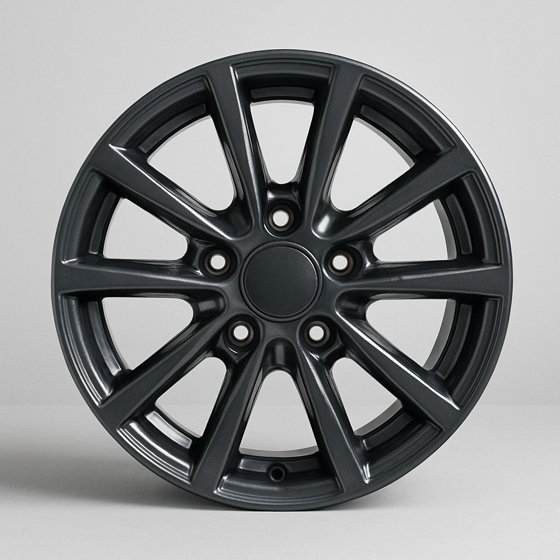
A wheel is one of the most heavily loaded exterior parts of a vehicle. Gravel flung at 100 km/h on the road, salt spread in winter, the heat of brake dust and acidic wheel cleaners used for washing all hit the same surface. That is why wheel coating is less a single-coat decorative job than a layered defense system. Below, following the sequence on the shop floor, I explain why alloy wheels are coated with multi-layer powder coating and what each coat does.
Why Powder Coating
Wheel manufacturers and coating shops have long been shifting from liquid paint to powder coating. The reason is not a single advantage but several practical benefits stacking up.
The first is film durability. Powder coating leaves a robust 60-90 µm film in a single pass; this thickness resists stone impact and scratching better than liquid paint. The second is no solvents: since powder coating has no VOC emissions, ventilation and waste loads in the shop are lower, and overspray that does not adhere is collected in the booth, sieved and reused in proportion with virgin powder (typically 20-30%). The third is repeatability; with the same recipe and oven profile, every wheel gives the same surface, which means color and texture consistency in mass production.
Resin selection is critical here. A wheel is an exterior part that sees constant sunlight, so epoxy, which yellows or chalks under UV, is not suitable on its own. The outer layer is generally polyester-based; it has good UV resistance and offers a wide choice of RAL colors. We compared in detail which resin fits where in the powder types article. The exact resin and cure window are determined by the powder manufacturer's technical datasheet (TDS).
Multi-Layer System
A wheel's durability lies not in a single coat but in the division of labor between layers. A standard alloy wheel is coated in three layers: primer, color coat and clear coat. Each coat is cured before the next one goes on.
Primer
The first coat forms a bridge between the metal and the color coat. It has two jobs: guaranteeing adhesion and forming a flexible buffer that absorbs the impact of stone chips. Good pretreatment beneath this coat is essential; without degreasing, conversion coating (chrome-free/nano-ceramic is becoming widespread) and rinsing, the primer will not hold either. We covered step by step why pretreatment is so decisive in the line stages article.
Color coat (base coat)
The second coat determines the appearance. It can be solid, metallic or pearlescent. On metallic wheels, the aluminum flakes are inside this coat and the orientation of the effect forms during application; that is why gun distance and motion are more sensitive for a metallic coat than for a solid color.
Clear coat
The transparent top coat is the real protector. It is the first line of defense against brake dust, acidic wheel cleaners, road salt and UV; it also carries the gloss and shade of the color coat. On metallic and diamond-cut wheels, the clear coat is mandatory, because if the effect/aluminum surface underneath is left unprotected, it quickly dulls and oxidizes.
Compatibility between coats requires system integrity. Primer, color and clear coat should, where possible, be selected from the same manufacturer's compatible range; mixing different systems can cause intercoat adhesion loss and the clear coat peeling off the color coat. The intercoat curing regime is also set according to the TDS. There are two extremes here: if the intermediate coat is under-cured, craters and adhesion problems appear in the top coat; if it is over-cured, the surface loses its smoothness and top coat adhesion weakens again. In practice, in most systems the color coat is brought to a partial gel point rather than full cure and the clear coat is applied over it in a wet-on-wet-like arrangement; the exact sequence and temperature again depend on the powder system.
Stone Chips and Chemicals
A wheel works under a different load from the rest of the body. It helps to look at these loads and the coating's response to each one separately.
| Stress factor | Source | Coating response |
|---|---|---|
| Stone / gravel impact | Road surface, high speed | Flexible primer absorbs impact, film limits local chipping |
| Brake dust heat | Brake pads, disc | Polyester film retains thermal stability, does not yellow |
| Road salt and moisture | Winter maintenance, wet roads | Pretreatment + primer delay underfilm corrosion |
| Acidic wheel cleaner | Washing chemicals | Clear coat acts as a chemical barrier |
| UV / sun | Constant outdoor exposure | Polyester color coat and clear coat slow fading |
The most common field defect is neglecting a small chip opened by a stone impact. From an impact point that has pierced the film down to the metal, moisture seeps under the primer; corrosion spreads laterally from there and the coating lifts layer by layer. On diamond-cut wheels this risk is even higher, because there is bare aluminum, not paint, under the clear coat, and at the slightest damage to the clear coat, oxidation starts directly on the visible surface.
That is why, in wheel coating, primer flexibility and film continuity matter more than thickness alone. Excessively thick film backfires: it gives orange peel, sagging and a layer that is more brittle on impact. The coating's real durability is therefore verified by testing, not by eye; cross-cut (ISO 2409), mandrel bend and impact tests are common checks. In markets with high corrosion expectations, creep from the scribe line is also evaluated with a salt spray test (ASTM B117), but this test has limited correlation with real field life and is not considered an absolute guarantee.
Caution
Aluminum alloy starts to melt at about 530-570 °C; the cure temperature is kept well below this (generally 180-200 °C metal temperature), but cast wheels carry another risk: gas trapped in pores within the metal escapes as it heats in the oven and causes pinholes and blisters in the clear coat. For risky castings, the part needs to go through an empty preheat (degassing) before coating to drive out the gas in advance.
Color and Effect
A wheel's appearance is the combined result of the color coat and the clear coat. Several common finish types differ from each other as processes.
- Solid color: The simplest system. Primer + single-tone color coat + clear coat. Most black, anthracite and white wheels are like this.
- Metallic: The color coat contains metal flakes, giving depth and sparkle. For the effect to be uniform, application motion and distance must be more controlled than with solid colors.
- Diamond cut (two-tone): The wheel is first coated, then its face is machined on a CNC lathe to expose bright bare aluminum. To keep the machined surface from oxidizing, only a transparent protective clear coat is applied over it. The contrast between the coated inner section and the bright machined outer face is this type's signature; however, because unprotected machined aluminum is vulnerable to filiform corrosion (worm track) if the clear coat is damaged, clear coat quality is critical here.
Choosing color and effect is not just a decorative preference; each type brings a different application discipline and a different durability profile. We brought together where wheels fit within automotive parts as a whole, and how they share a coating strategy with other components, on the automotive solutions page. Exact coat count, thickness and cure values vary with the part alloy, whether it is cast or forged, and the selected powder system; field measurement and the TDS are the reference.
Frequently Asked Questions
A standard alloy wheel is coated in three layers: a primer for adhesion and impact buffering, a color coat for appearance and a protective clear coat. On a diamond-cut wheel, only clear coat is applied to the machined surface.
Yes, when applied correctly. The flexible primer absorbs stone chips, the polyester color coat resists UV and heat, and the clear coat forms a chemical barrier against acidic wheel cleaners and road salt. If chips that pierce the film are neglected, corrosion starts underneath.
It is a wheel type whose face is machined on a CNC lathe after coating to expose bright bare aluminum. To keep the machined surface from oxidizing, only a transparent protective clear coat is applied over it.