In Short
- A powder coating line consists of five basic stations: racking, pretreatment tunnel, drying, application booth and curing oven.
- Line speed is usually set not by the oven but by the number of rinse stages in the pretreatment tunnel and the drying time.
- After the part reaches TARGET temperature (PMT), polyester cure is counted as 20–25 min at 180 °C or 10–15 min at 200 °C; the exact value is in the powder’s TDS.
- Capacity is limited by conveyor speed, hanger density and oven length together; the slowest station slows down the entire line.
The most common mistake when setting up a new line is to start with the oven or the gun. Yet the step that determines how many years the coating will last on a part’s surface is completed in the pretreatment tunnel, before the part even enters the booth. Let’s go through a powder coating line station by station and look at what slows you down and what causes defects at each one.
Overall Line Flow
The flow of a standard line is: racking → pretreatment → drying → powder application → curing → cooling → unloading. Parts are hung on an overhead conveyor and pass through the stations in this order. On a continuous (monorail) conveyor, parts move at a constant speed; in a power-and-free system, stops and accumulation are possible, so speed differences between pretreatment and the oven can be managed.
The critical point is this: line output is limited by the speed of the slowest station. Usually this station is a multi-stage pretreatment tunnel or a curing oven that is not long enough. That is why sizing the line as a whole is more important than selecting individual pieces of equipment.
The layout plan is also among the earliest decisions. If the conveyor route is closed in a U or O shape, loading and unloading are concentrated in the same area and staff move around less. Separating the airflow between heat-producing ovens and the powder application booth prevents hot air from carrying powder into the booth and causing stains.
| Station | Function | Typical parameter |
|---|---|---|
| Racking | Hanging parts, grounding, contact | Resistance < 1 MΩ target |
| Pretreatment tunnel | Degreasing + conversion coating + rinsing | Degreasing 45–60 °C, 3–7 stages |
| Dry-off oven | Evaporating surface water | 120–160 °C, 8–15 min |
| Application booth | Electrostatic powder application + recovery | 60–100 kV corona |
| Curing oven | Melting + cross-linking (PMT) | 160–200 °C, 10–25 min PMT |
Racking
Racking is the station that works quietly but directly determines transfer efficiency. Powder particles are attracted to grounded metal; if there is no clean metal-to-metal contact between the part and the hanger, and between the hanger and the conveyor, the charge cannot drain and the powder will not cling. In practice, the target is a total resistance below 1 MΩ from the part to the conveyor.
The most common problem is cured coating built up on the hanger from previous cycles. This coating is an insulator; after a few cycles the contact point becomes isolated, and parts on that hanger show low thickness or even uncoated areas. That is why hangers are cleaned periodically in a burn-off oven or by chemical stripping. Hanger density also matters: hanging parts too close together increases shadowing and Faraday problems, while hanging them too sparsely reduces capacity.
Caution
The conveyor rail and hanger contact points are affected by powder contamination. Hanger cleaning is not a maintenance item but a quality item; when neglected, the symptom shows up on the part while the root cause is in the hanger, which makes diagnosis harder.
Pretreatment Tunnel
This is where the real life of the coating is determined. A classic tunnel goes through the following stages: degreasing, first rinse, conversion coating (iron/zinc phosphate or nano-ceramic), second rinse and finally a demineralized water rinse. The number of stages ranges from 3 to 7; the more rinses, the cleaner the surface, but also the longer the tunnel and the lower the line speed.
The degreasing bath typically runs at 45–60 °C. Oil or silicone left on the surface, or salt residue from poor rinsing, shows up later in the booth as craters and loss of adhesion. Nano-ceramic conversion coatings operate at lower temperatures than traditional phosphate and produce less waste sludge; in architectural work, chrome-free systems have become widespread as hexavalent chromium has been phased out. For details on tunnel design, it is worth looking at the stage diagram in the pretreatment: phosphate and nano-ceramic article.
A wet part coming out of pretreatment cannot go straight to coating; the surface water is evaporated in a dry-off oven. Drying is typically done at 120–160 °C and takes 8–15 min depending on the part’s mass. If thick cast parts do not dry completely in this time, moisture-related pinholes and adhesion problems start in the booth.
Application Booth
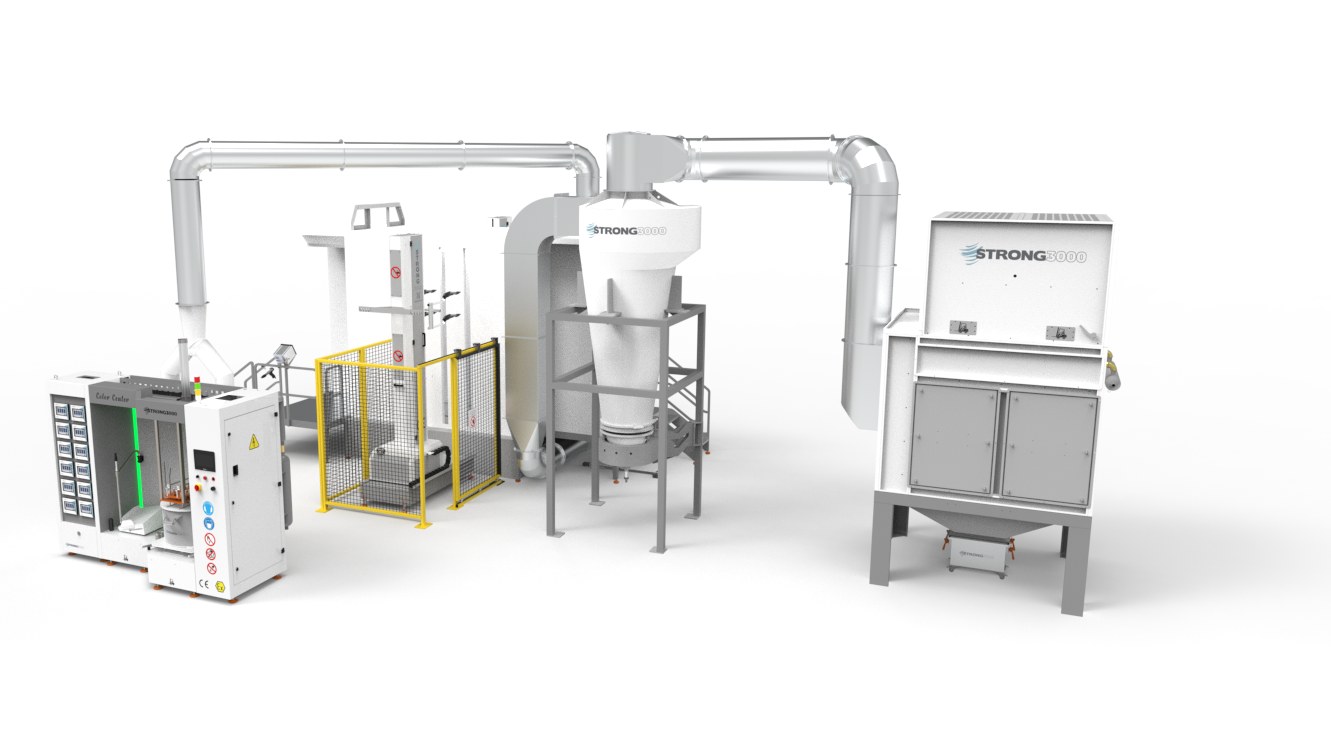
The powder is electrostatically charged and sprayed onto the grounded part. Corona guns charge with free ions in the 60–100 kV range; tribo guns charge by friction, without ions. Booth selection depends on how many colors you run: with one or two colors a day, a cartridge/filter booth stands out; with three or more colors a day, a quick-clean PVC booth with monocyclone recovery. You can narrow down the right booth type by part size and number of colors using the booth selection guide.
Application is set up at three levels:
- Manual: Flexible for low volume, frequent color changes and complex, one-off parts, but repeatability depends on the operator.
- Automatic (reciprocator): Fixed guns moving up and down on a vertical axis; provide high repeatability on flat parts and profiles.
- Robotic / intelligent motion: Reduces the Faraday effect on variable geometries and deep recesses by adjusting gun angle and distance.
Most real lines operate in a mixed mode: automatic guns coat the main body of the surface, and an operator touches up corners and recesses by hand. Recovery efficiency reaches up to 95% with standard powder; with powders high in fines below 10 µm, it drops to ~85%. Reclaimed powder is used blended with virgin powder in a defined ratio (typically 20–30%); otherwise, the buildup of fines degrades film quality.
Tip
Choose the booth based on your color change scenario, not just today’s volume. If you will be running three colors a day a year from now, starting with a filter booth condemns you to 30–45 min of cleaning losses at every color change.
Curing Oven
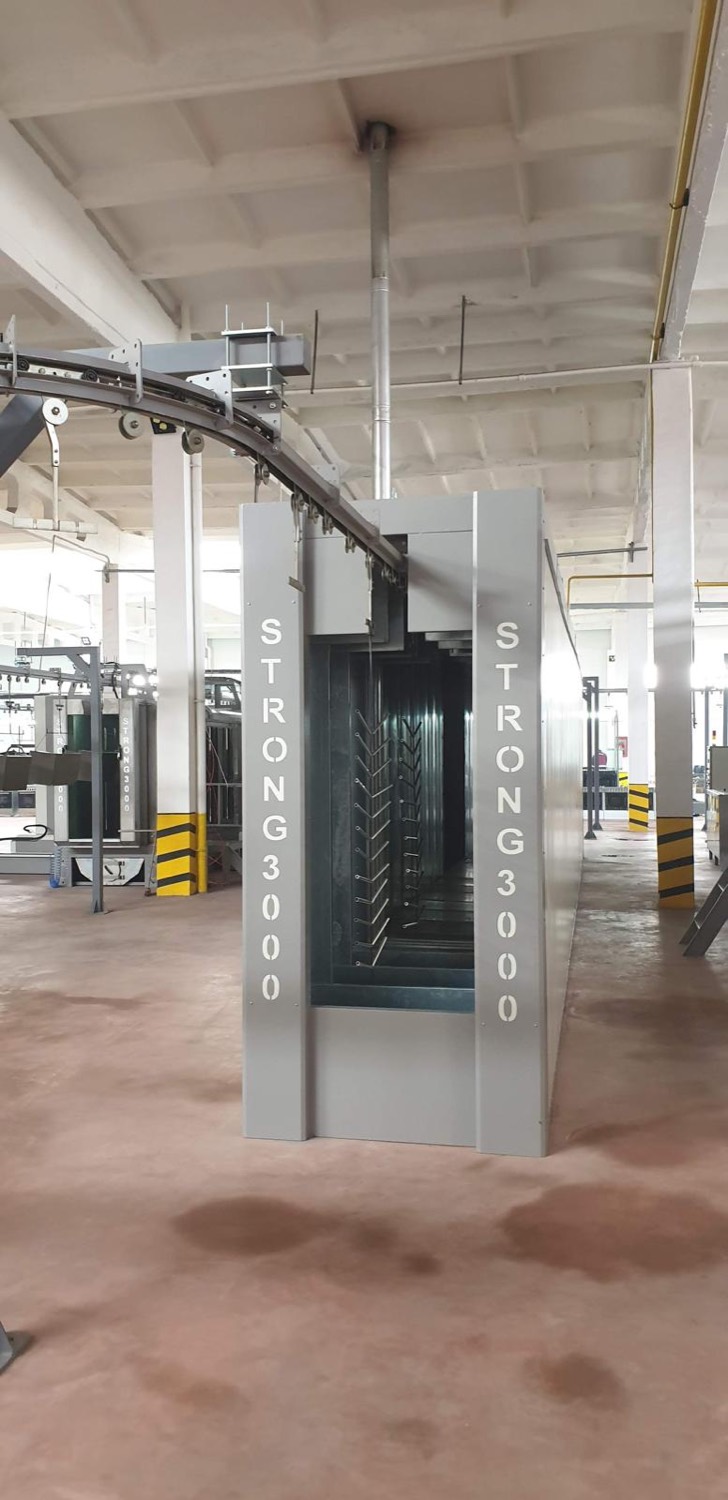
Powder coating first melts with heat and then cross-links chemically. What counts here is not the oven air temperature but the metal temperature the part reaches (PMT — Peak Metal Temperature). Time is counted after the part reaches target temperature. For polyester, about 20–25 min at 180 °C and 10–15 min at 200 °C are typical values; epoxy cures in the 150–180 °C range and hybrid in the 160–190 °C range. The exact recipe is always stated on the powder’s technical datasheet.
Oven types fall into two main branches: convection (hot air circulation) ovens are general-purpose; infrared (IR) ovens provide very fast heating on thin sheet but cannot distribute heat evenly on shadowed geometries. In practice the two are combined: rapid surface heating with IR at the entry, followed by equalization with convection.
Part mass determines oven length. While thin sheet reaches PMT within minutes, thick castings or densely hung parts reach the same temperature later. If you ignore this difference and set the oven only by air temperature, thin parts overcure and become brittle while thick parts undercure and lose adhesion. Running parts of different mass on the same oven profile is the most common hidden quality problem.
The way to verify the oven profile is measurement, not guesswork. A heat-resistant data logger is attached to the part and sent through the oven with it; at the exit, a graph shows how many minutes the part actually spent at which temperature. This measurement also reveals burner imbalances in different zones and heat leakage at the entry and exit curtains. On a new line, mapping this profile once for each typical part at initial commissioning prevents most of the complaints in the following months.
Capacity Planning
Capacity is not a single number but the intersection of three constraints: conveyor speed, the number of parts per hanger and the oven’s ability to bring the part to PMT at that speed. For example, if the oven length is 20 m and the required cure time is 20 min, conveyor speed can be at most 1 m/min. This speed also determines the transit time through the pretreatment tunnel and drying; if the tunnel cannot rinse adequately at this speed, you have to reduce the speed.
For a practical calculation, pin down these three values: target daily part count, hanger area per part and the cycle time of the slowest station. These three directly give you the required conveyor speed and therefore the oven and tunnel lengths. Studying how this sizing is done holistically in a turnkey installation, using the turnkey powder coating line example, gives a sounder result than selecting stations one by one.
A final warning: do not fit the line exactly to today’s volume. Adding a pretreatment stage, extending the oven or adding a second booth row later is very costly. Leaving 20–30% growth margin in the conveyor route and building layout is cheaper than rebuilding the entire line a few years later.
Frequently Asked Questions
The basic stations are racking, the pretreatment tunnel (degreasing + conversion coating + rinsing), the dry-off oven, the electrostatic application booth and the curing oven. These are linked by an overhead conveyor.
Manual offers flexibility for low volume and frequent color changes; for high, repeatable production, an automatic reciprocator or robot is preferred. Most real lines operate in a mixed mode of automatic application plus manual touch-up.
Capacity is the intersection of conveyor speed, the number of parts per hanger and the cycle time of the slowest station. Cure time and oven length determine the maximum conveyor speed; this speed also constrains transit through the pretreatment tunnel.