In Short
- With fixed guns, or guns that move up and down in a single plane, film thickness varies across a part's protrusions and recesses; it exceeds 120 µm in some areas and drops below 40 µm in the recesses.
- Motion that adapts gun distance, angle and speed to the part geometry narrows the thickness distribution and improves penetration into corners and cavities.
- The Faraday cage effect cannot be solved by motion alone; kV/µA settings, gun angle and, if needed, a tribo gun all work together.
- Targeted application reduces overspray and fines build-up, preserving recovery quality.
A conveyor carries a part past the gun at 4 m/min. The gun is fixed; the part's flat face measures 75 µm, but the inside of a 30 mm deep channel stays at 35 µm and the edge of a protruding flange climbs to 130 µm. Same part, same powder, same oven; three different thicknesses simply because the geometry between gun and surface changes. This is the most insidious obstacle to uniformity in powder coating, and it is directly tied to how the gun moves.
The Limits of Fixed Motion
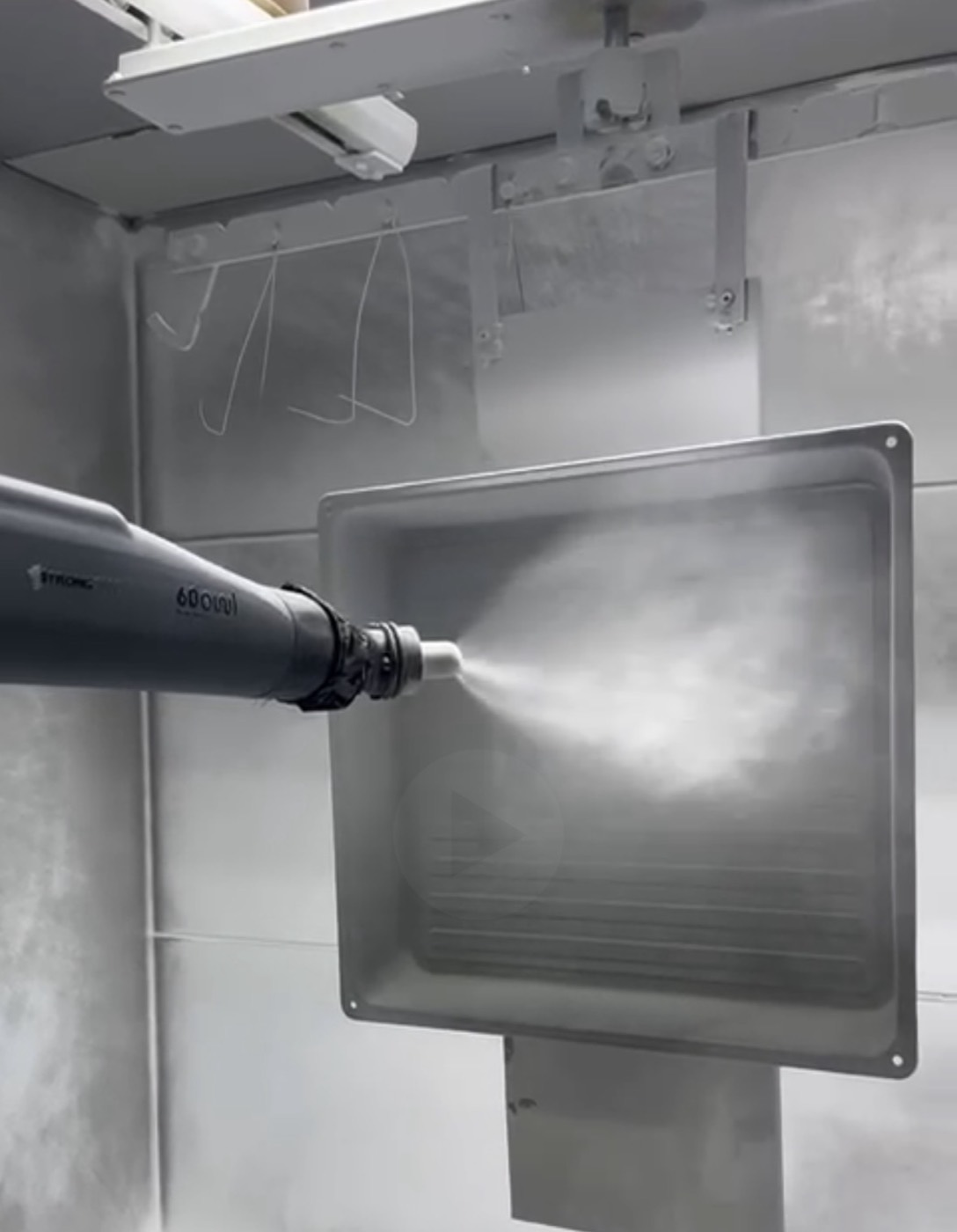
In electrostatic powder coating, two things carry a particle to the surface: the powder cloud carried by the air, and the electric field that pulls the charged particle toward the part. Both are sensitive to distance and angle. When the gun is close and perpendicular to the surface, the field lines are dense and the powder cloud is compact; thickness builds quickly. As the gun moves away or meets the surface at an angle, the field weakens, the cloud disperses and that area is starved of powder.
On conventional automatic lines the gun is either fixed or moves up and down along a single axis (usually vertical) on a reciprocator. This works well on flat, single-plane parts. The problem starts when the part has a third dimension: the recesses and ridges of a profile, the inner face of a box section, the shadowed back of a welded bracket. Because the gun always travels in the same plane, its distance and angle to these areas keep changing, and the thickness changes with them.
The result is a loss on two fronts. Protruding areas are coated thicker than necessary; that is wasted powder, and as film thickness rises, so does the risk of orange peel and sagging. Recessed and shadowed areas stay thin; coverage weakens and corrosion protection drops. To compensate, the operator turns all the guns up a little, and the thick areas swell even further. This is exactly where fixed motion hits its limit: a single setting cannot suit different geometries at the same time.
Adaptive Motion
The idea is simple: the gun should not move blindly past the part but according to the geometry in front of it. An adaptive motion gun adjusts three variables as the part goes by.
- Distance: In most jobs the gun-to-surface gap is kept in the 150–250 mm range. As a protruding area approaches, the gun pulls back to prevent excess build-up; in a recessed area it moves in slightly to revive the field and the cloud.
- Angle: Field lines land most efficiently when the gun is perpendicular to the surface. On an inclined surface or the side wall of a channel, turning the gun angle directs the powder into the shadowed area.
- Speed and timing: The gun's travel speed and spray time vary by zone. It passes quickly over wide flat areas and pauses briefly to deliver extra powder in narrow, deep zones.
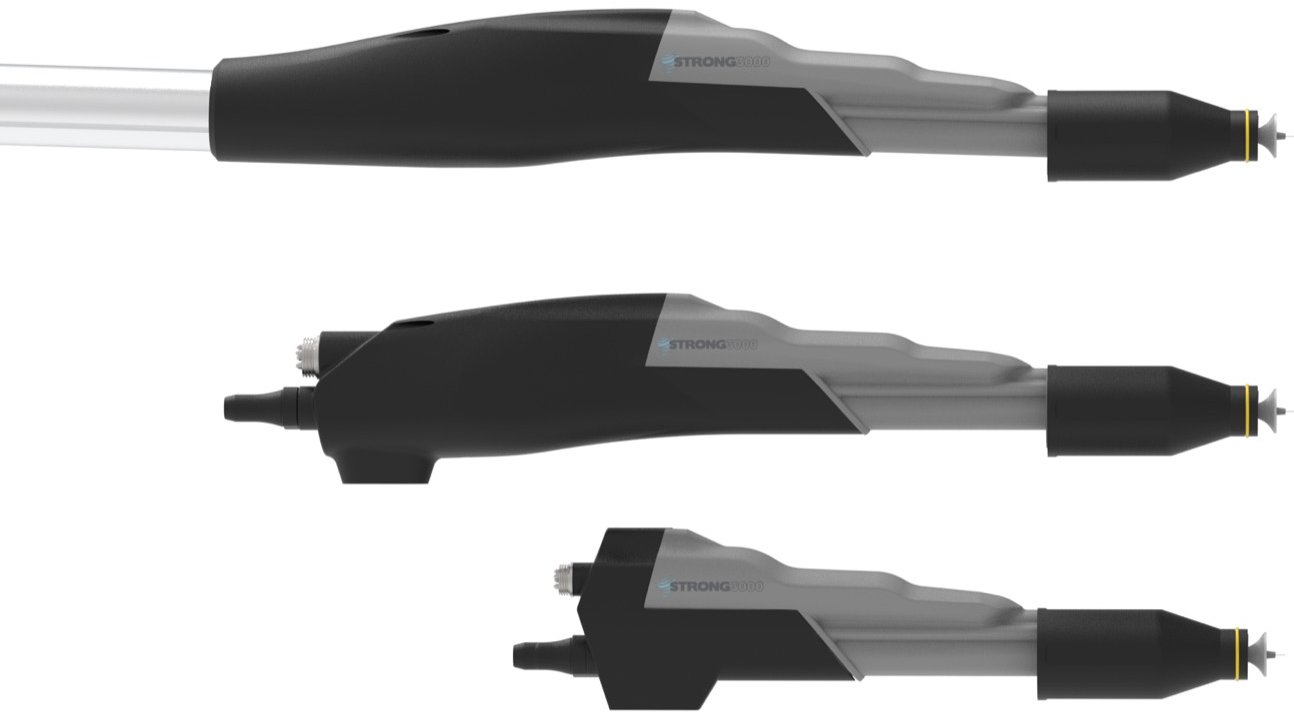
STRONG3000's OWL Intelligent Motion Gun works on this logic: instead of oscillating along a single axis, it guides the gun according to the part profile. What matters is not the device's name but the principle; the more constant the distance and angle between gun and surface, the more uniform the film. This approach also changes the classic choice between automatic and manual guns: you get repeatability from automation and adaptation to geometry from intelligent motion.
Tip
Don't tune the motion blindly. Take readings with a magnetic film thickness gauge (DFT) at a few critical points on the part (the most protruding spot, the deepest recess, the shadowed back face). Set a target band (for example 60–90 µm) and calibrate the motion profile against these readings. Verify the setting in microns, not by eye.
Effect on Faraday
Charged particles struggle to enter inside corners, cavities and cage-like structures. The electric field concentrates at the outer edge of these areas and cannot reach the bottom; particles stick to the edge and the inner surface goes bare. This is called the Faraday cage effect, and motion alone does not eliminate it. What motion contributes is making the other countermeasures that push this limit more effective.
To reach the bottom of a channel or box section, angling the gun toward that area and shortening the distance makes a real difference. But the electrostatic settings must follow. The counterintuitive fix for Faraday is often lowering the voltage: reducing kV and current (µA) softens the field concentration at the edge and lets particles get past the corner and inside. High kV, counterintuitively, leaves deep areas bare.
The sequence works like this: first the bottoms and cavities are coated with intelligent motion at the right angle and low kV; then the flat outer surfaces are finished with higher kV at normal distance. If the geometry is truly enclosed (narrow internal volume, deep blind hole), no corona setting may be enough; that is where a tribo gun, which produces no free ions, or manual touch-up comes in. Intelligent motion does not replace these tools; it extends their reach.
Caution
An intelligent motion gun does not solve the Faraday problem on its own. If you bring the gun close to a deep cavity while keeping kV high, field concentration at the edge increases and the bottom of the cavity still stays bare; on top of that, the risk of back-ionization pitting and craters at the edge grows. Without adjusting motion, angle and voltage together, you won't get results.
Efficiency and Waste
A uniform film is not just a quality issue; it is straight material economics. Coating protruding areas unnecessarily thick means burying extra powder in that part. Keeping thickness within the 60–90 µm target band delivers the performance specified in the TDS and lowers powder consumption per square meter.
The second gain of targeted application is on the recovery side. When the gun aims powder accurately at the part, less of it hangs in the air and escapes into the booth; in other words, transfer efficiency rises. This is not just a saving in the moment but long-term quality protection. Powder escaping into the booth is recovered and reused, but with every cycle its fines (10 µm) content rises a little. Fines build-up lowers recovery efficiency and degrades fluidity, causing new defects. Losing less powder in the first place is the cheapest way to protect the quality of recovered powder. For more on the recovery side, see the monocyclone vs filter booth comparison.
To give a rough frame: on a well-set-up line with standard powder, combined utilization from transfer efficiency and recovery can exceed 90%; with special powders high in fines this figure drops. The exact number depends on the powder, the part and the line settings, and is confirmed by field measurement. The message here is not a percentage promise but a direction: adapting the gun to the geometry is one of the rare interventions that improves film quality and material efficiency at the same time.
When It Pays Off, When It's Overkill
An intelligent motion gun is not an automatic requirement for every line. On parts with simple geometry, such as flat sheet or single-plane panels, a well-tuned fixed or reciprocator setup already delivers a uniform film; the return on the added complexity stays limited. The investment really shows its value under these conditions:
- When geometry varies: On profiled, box-section, multi-step or welded-bracket parts, distance and angle change constantly, so adaptive motion directly closes the thickness gap.
- When there are Faraday zones: On parts with corners and inner surfaces, such as electrical cabinets, wire mesh or cored castings, motion increases penetration together with kV settings and, if needed, tribo.
- When high volume and powder cost dominate: In series production where powder consumption per square meter makes a difference, the efficiency gain from targeted application pays back quickly.
When deciding, pick up the part, measure the thickness at critical points and see how much scatter the current setup produces. If the problem is a geometry that a single-plane gun cannot handle, intelligent motion makes sense. If the problem lies in pretreatment or curing, changing the gun gains you nothing; you first need to place the root cause correctly. The point of this article is not to promote equipment but to show how motion affects coating physics; exact settings are always confirmed by the powder's technical datasheet and field trials.
Frequently Asked Questions
By adapting the distance and angle between gun and surface to the part geometry, it keeps film thickness in a narrower band (for example 60–90 µm). It reduces excess build-up on protrusions and thinning in recesses, improving both quality and powder efficiency.
It directs the gun into corners and cavities at the right angle and from a closer distance. But that alone is not enough; it must work together with reduced kV and current and, if needed, a tribo gun or manual touch-up. If the voltage is kept high, the bottom still stays bare.
When powder is aimed accurately at the part, less escapes into the booth and transfer efficiency rises. Losing less powder also slows the build-up of fines (10 µm) in recovered powder and preserves recovery quality. The exact rate is confirmed by field measurement, depending on the powder, the part and the line settings.