In Short
- Pretreatment for architectural aluminum no longer contains chromium-6; nano-ceramic or chrome-free conversion coating has become the standard.
- Profile length and production volume decide whether the line is vertical or horizontal; 6–7 m profiles are mostly processed on vertical lines.
- For facade work the acceptance criterion is the Qualicoat class; the class should be written into the contract explicitly.
- Wood and marble finishes are applied by sublimation transfer, not as a separate color coat.
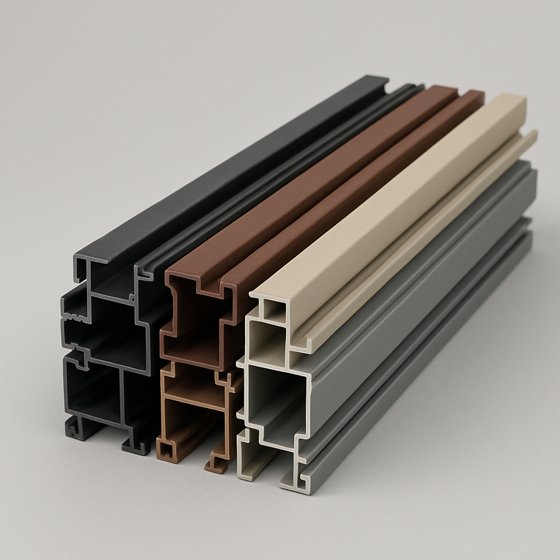
An aluminum profile line differs from a general-purpose powder coating plant in several ways. The part is thin-walled, long and mostly destined for facades, so both its geometry and its durability expectations differ from standard sheet metal work. Although extrusions come off the press relatively clean, drawing oil, oxide and shop contamination still remain on the surface. That is why most of the quality is determined in the pretreatment tanks, before the gun even comes into play.
Chrome-Free Pretreatment
For years the standard conversion coating for architectural aluminum was yellow or green chromate, i.e. chromium-6 based. It performed well for corrosion and adhesion, but chromium-6 is carcinogenic and environmental legislation has taken it out of use. Today the preference in architecture is chrome-free systems: mainly zirconium/titanium-based nano-ceramic conversion coatings and chromium-3 alternatives.
The steps of a typical chrome-free line run as follows:
- Alkaline degreasing — the step that removes drawing oil and organic soil.
- Acid etching — a set amount of aluminum is removed from the surface; a material loss of 0.8–2.0 g/m² is usually targeted, which is the measure that the surface has truly been cleaned.
- Rinsing — after every chemical step, so that drag-out contamination is not carried into the next tank.
- Nano-ceramic conversion coating — a thin Zr/Ti layer on the order of a few hundred mg/m² by weight; it provides adhesion and resistance to under-film corrosion.
- Final rinse (demineralized water) — rinse water conductivity is kept low (usually 30 µS/cm); otherwise dried salt spots leave weak points under the film.
Compared with chromate, nano-ceramic works at lower temperature, produces less sludge and has a lighter waste load. In return it is more sensitive to surface cleanliness and bath control; if conductivity, pH and etch rate are not monitored regularly, adhesion is the first thing to weaken. We covered the choice of conversion chemistries and the comparison with phosphate in detail in the pretreatment article.
After pretreatment there is also a drying step, and on architectural lines it is often underestimated. If water collecting in a profile's internal channels and blind holes is not fully dried, it evaporates in the curing oven and leaves pinholes and blisters under the film. For closed-section profiles, plan a hanging position that lets water drain or allow sufficient drying time; a part that looks dry does not mean its internal channels are dry.
Caution
Overdoing the etching step to “remove a bit extra against corrosion” backfires. Over-etching thins the profile section, rounds sharp corners and leaves a dull, uneven surface. Measure the material loss gravimetrically and keep it within the range given in the TDS.
Vertical / Horizontal Line
The decision depends largely on profile length and volume. Architectural extrusions mostly come in 6 m, in some jobs 7 m lengths; at this length, carrying the part horizontally becomes difficult in terms of both floor space and hanger deflection.
On a vertical line profiles are hung from one end and pass through the pretreatment tunnel, dryer, booth and oven in an upright position. The advantages are clear: long profiles are processed in a small footprint, dripping and build-up are better controlled on vertical surfaces, and automation is easy at high volume. The price is height; the pretreatment tunnel and oven must be as tall as the profile length plus a maneuvering allowance, which means building and investment cost.
On a horizontal line profiles travel on horizontal hangers. It offers a lower structure and a lower entry cost, and it is flexible for mixed/short parts and low-to-medium volumes. Its limit shows with long profiles: as hanger spacing increases, the risk of deflection and contact marks grows, and fewer parts are processed in the same area.
| Criterion | Vertical line | Horizontal line |
|---|---|---|
| Suitable profile length | Long (6–7 m) | Short to medium |
| Footprint | Small, tall building | Wide, low building |
| Volume | High-volume series | Low to medium, flexible |
| Investment | High | Lower |
| Deflection risk | Low (hung vertically) | Increases on long parts |
A problem common to both lines is powder failing to reach the corners and channels of hollow profiles. On thin-walled, closed-section profiles, powder sticks to the outer surface where the electric field concentrates, and concave areas stay weak. This is the Faraday cage effect; reducing voltage and current, adjusting gun distance/angle, and intelligent motion or robotic application all help cover these areas.
Qualicoat Quality
For facade aluminum, “it was coated well” says nothing on its own; the industry's common language is Qualicoat. Qualicoat audits both the powder material and the applicator's line, and defines classes by durability:
- Class 1 — standard polyester; general architectural use.
- Class 2 — super-durable polyester (SDP); high UV exposure, long service life.
- Class 3 — the highest durability class; the most demanding facade requirements.
The higher the class, the higher the gloss and color retention threshold required in Florida outdoor exposure testing. On the applicator side, Qualicoat requires regular testing of film thickness, adhesion (ISO 2409 cross-cut), impact, boiling water and salt spray. In architectural work the target film thickness is usually at least 60 µm, measured not at a single point but at several points around the profile.
Simply writing “Qualicoat” in a facade specification is not enough in practice. Specifying the required class (Class 1/2/3), the minimum film thickness and the accepted salt spray hours in numbers puts both powder procurement and on-site acceptance discussions on an objective footing from the start. The points that most often fail inspection are also well known: adhesion loss from inadequate rinsing, film thickness below target in corners and channels, and shade drift between color batches. All three are signs of a shortfall on the line, not a defect in the powder itself.
Once you have chosen the right class of powder, you can check the resin-dependent part of its outdoor behavior, along with the classes and test methods, in the Qualicoat standard article. For all industry-specific requirements, see the aluminum solutions page.
Wood Grain / Sublimation
Demand for wood- and marble-patterned aluminum in architecture is high; the method behind it is not a separate paint coat but sublimation transfer. First a solid base color powder coat is applied to the profile and cured. Then a film printed with the pattern is wrapped around it, or the profile is wrapped in patterned paper and vacuum-sealed. When heat is applied (usually in the 180–200 °C range, for a few minutes), the ink on the film vaporizes and penetrates into the powder coating layer; the pattern forms inside the coating, not on the surface.
That is why a wood-grain profile does not behave mechanically differently from a solid-color profile; the pattern is not a thin layer on top of the surface but embedded in the film. Its UV behavior still depends on the base powder's resin, however; if it is to be used on a facade, the base layer must also be an exterior-grade class. Because sublimation wraps all surfaces of a three-dimensional profile in a single operation, unlike printing on flat sheet, it can also cover corners and channels with the pattern.
A final note on color and effects: batch consistency is critical in architectural work. When profiles coated at different times end up side by side on the same facade, shade differences are visible to the eye. That is why on large facade projects the powder is sourced from the same production batch and a reference panel is kept. When the right resin, controlled pretreatment and consistent film thickness come together, an aluminum profile reaches the decades of service expected on a facade.
Frequently Asked Questions
The profile first goes through degreasing, acid etching and rinsing, followed by a chrome-free nano-ceramic conversion coating. After drying, electrostatic powder is applied and, for polyester, typically cured at a part temperature of 180–200 °C. Exact values are given in the powder's technical datasheet.
Profile length and volume decide. For 6–7 m architectural profiles and high-volume series, a vertical line works in a small footprint and reduces deflection; for short-to-medium parts, low-to-medium volume and lower investment, a horizontal line is more flexible.
By sublimation transfer. A base color powder coat is first cured on the profile, a pattern-printed film is wrapped over it, and heat drives the ink into the coating. The pattern is embedded in the film rather than sitting on top of the surface, so it behaves much like a solid color in terms of wear.