In Short
- Corona charges particles with a high-voltage ion cloud, tribo with friction; the second method produces no free ions.
- Free ions add speed on flat surfaces but amplify the Faraday cage effect in deep corners and recesses.
- Tribo generally gives better penetration on recessed and wire-mesh parts; on the other hand, it is sensitive to powder chemistry and transfer efficiency can be lower.
- On most lines, the right answer is not “one or the other” but using corona and tribo together, depending on the part.
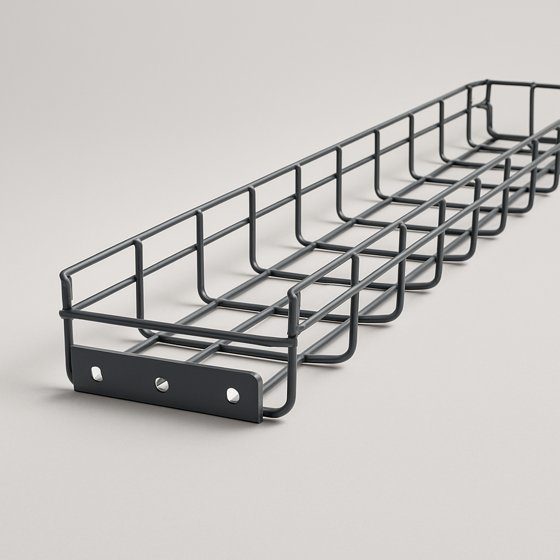
Same powder, same part, same oven. In the morning, the inside corners of a cable tray coated with a corona gun are left bare; in the afternoon, with a tribo gun, the corners of the same part are covered. The difference is not in the powder but in how the charge is given to the particle. There are two charging methods in electrostatic application, and the one you choose directly determines the result, especially on parts with difficult geometry.
We covered the fundamentals of charging in the electrostatic powder coating article; here the focus is on the practical differences between corona and tribo and which causes fewer problems in which job.
Corona Charging
At the tip of a corona gun there is a thin electrode. A high voltage on the order of 60–100 kV is applied to this electrode. The strong electric field at the tip ionizes the air and creates a zone full of free ions. Powder particles leaving the gun pick up charge as they pass through this ion cloud. In other words, the particle is charged not directly by the electrode but by the ions in the surrounding air.
The method’s greatest strength is its flexibility. Epoxy, polyester, hybrid — whatever the powder chemistry, corona charges it. Initial charging is fast, transfer efficiency on flat, wide surfaces is high, and the adjustment window is wide. That is why the vast majority of guns in the field are corona type.
The price is the free ions the gun produces. Ions left over from charging the particles pile up on the part surface. This buildup causes two problems. First, the accumulated charge starts to repel incoming particles and limits the film thickness you can achieve in a single pass. Second, as the charge accumulated on the surface discharges, back ionization occurs, leaving small crater- and pinhole-like marks in the film. We detailed this behavior and general defect diagnosis in the powder coating defects article.
Tip
With corona, “higher kV is always better” is not true. On flat surfaces 80–100 kV usually does the job, but on parts with deep corners and recesses, pulling kV down to the 40–60 band and limiting current (µA) lets the particles enter the recess.
Tribo Charging
A tribo (tribostatic) gun has no high voltage. Particles gain charge through contact with a friction surface inside the gun (usually a PTFE/Teflon channel). During friction, electrons transfer between the particle and the surface; the particle becomes positively charged, and the gun discharges the opposite charge to ground. The key point: no free ions are produced.
The absence of free ions eliminates the ion cloud and back ionization specific to corona. Since there is no ion field pushing the particle in, the powder follows the part’s field lines with its own charge alone. This means easier spreading into deep corners, recesses and concave surfaces.
Tribo has its own limits. Because charging depends entirely on friction, it is sensitive to powder chemistry; not every formulation charges with the same efficiency in every tribo gun. Some powders are specially formulated for tribo. Friction surfaces wear over time and charging drops; keeping the inside of the gun clean and dry is essential. Damp powder or moist compressed air markedly weakens tribo charging. In general, tribo’s transfer efficiency on flat surfaces may fall below that of a well-tuned corona gun.
Caution
Do not load just any powder into a tribo gun and expect corona efficiency. Whether the powder is suitable for tribo charging — the powder manufacturer’s technical data sheet (TDS) is the reference. With an unsuitable powder, tribo gives both low charge and low transfer efficiency.
Faraday and Penetration
The difference between the two methods is clearest on parts where the Faraday cage effect comes into play. In short, the Faraday effect works like this: electric field lines concentrate on the outer edges and corners of a recess and do not reach its bottom. Because charged particles follow these field lines, they quickly cover the corners and edges, but the inner area is left bare.
With corona, this effect is amplified, because the gun produces not only charged particles but also an abundance of free ions. These ions form a charge curtain at the mouth of the recess and push incoming particles back. The result: thick corners, a thin or bare bottom. To get into a recess with corona, you need to lower kV and current, change the gun distance and angle and, more often than not, touch up manually.
With tribo, since there is no free-ion curtain, the particle can be carried all the way into the recess by its own charge. This is where tribo’s penetration advantage shows on parts such as wire mesh, grates, deep-drawn sheet and partitioned cabinet bodies. Still, tribo is not magic; the Faraday effect does not disappear completely, it only becomes manageable.
A third route is to move the gun rather than change the charging method. Intelligent motion or robotic application positions the gun at the right angle and distance toward the recess, physically reducing the Faraday effect. In practice, the most robust solution is often the combination of “right charging + right motion”; simply changing the gun type is not always enough.
Corona and tribo side by side
| Feature | Corona | Tribo |
|---|---|---|
| Charging mechanism | Ion bombardment (60–100 kV) | Friction, no high voltage |
| Free ions | Yes (in abundance) | No |
| Back ionization risk | Yes (craters/pinholes at excessive kV) | Practically none |
| Faraday / recess penetration | Weak; requires adjustment and touch-up | Markedly better |
| Flat surface transfer efficiency | Generally high | Medium to high |
| Sensitivity to powder chemistry | Low (most powders work) | High (suitable powder required) |
| Sensitivity to moisture / maintenance | Medium | High (dry powder and air essential) |
| Initial charging speed | Fast | Slower |
| Typical use | Flat sheet, profiles, general work | Wire mesh, recesses, inside corners |
Which One for Which Job
The choice cannot be reduced to a single question, but when part geometry and color pattern are considered together, the decision becomes clear.
- Flat and open geometries (sheet panels, straight profiles, box bodies): Corona covers easily, transfer efficiency is high, and there is no need to accept the powder restrictions that tribo brings.
- Deep recesses, inside corners, wire mesh, grates: Tribo excels at penetration. If you insist on corona, you will lose time lowering kV/µA and touching up manually.
- Mixed production (some parts flat, some recessed): A common solution is to do the main coverage with automatic corona guns and touch up the difficult areas with a separate gun. We covered how automatic and manual application are divided in the automatic or manual article.
- Single color, long runs: Stocking a special powder for tribo can make sense; the powder choice is fixed and tribo’s chemistry sensitivity stops being a problem.
- Frequent color changes: Cleaning the internal channels of a tribo gun at every color can be more laborious than with corona; take this into account if fast color change is your priority.
In practice, many lines do not stick to a single method. Main coverage is done quickly and efficiently with corona; areas where the Faraday effect locks in are solved with a tribo gun or a gun moving at the right angle. When deciding, do a trial coating: coating the same part with both methods and measuring film thickness (µm) at the corners and the bottom is a more reliable guide than catalog promises. The exact settings are established according to the powder’s TDS and on-site measurement.
Frequently Asked Questions
A tribo gun charges particles by friction instead of high voltage and produces no free ions. As a result, on parts where the Faraday effect is strong, such as deep corners, recesses and wire mesh, the powder enters the recess more easily.
There is no single right answer; it depends on the part. On flat and open surfaces, corona is faster and gives higher transfer efficiency. In deep recesses and inside corners, tribo provides better penetration. On most lines, the two are used together.
Generally tribo. Since there is no free-ion curtain, the particle can be carried all the way to the bottom of the recess. To get into a recess with corona, you need to lower kV and current, change the gun angle and, more often than not, touch up manually.