In Short
- A water heater's inner tank operates under constant hot water and changing temperatures; here enamel provides a glassy, non-porous barrier.
- Application is done with powder or wet enamel, followed by firing in the 780–850 °C range for steel.
- The most critical areas are the weld seams; a metal surface altered by heat input makes even enamel coverage difficult.
- After coating, freedom from pores is verified with a high-voltage holiday (spark) test; typical values are in the 1000–4000 V range.
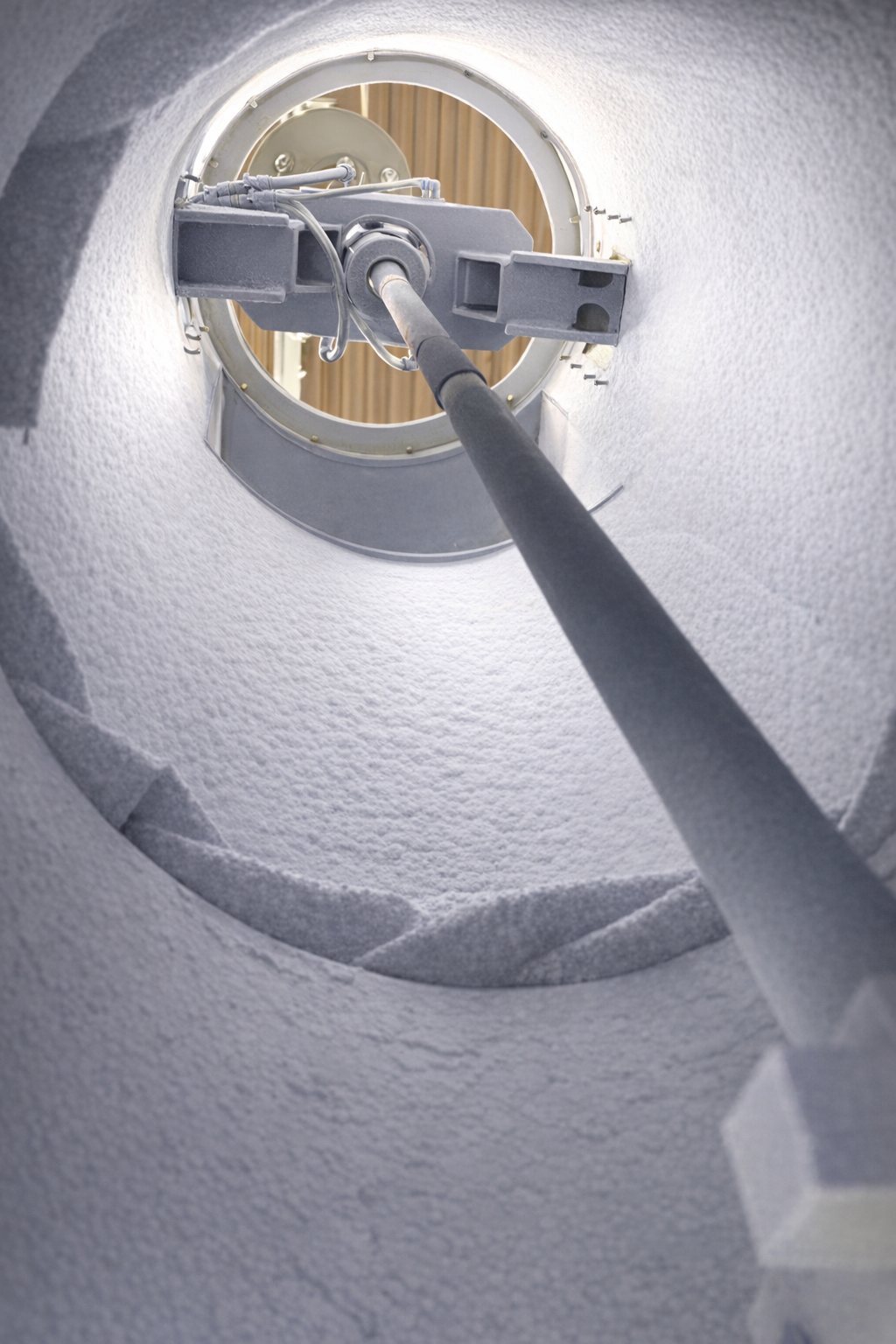
Whether a water heater lasts 8–10 years is often decided on the inner surface of its tank. Water sitting at 60–70 °C, together with chlorides and dissolved oxygen, constantly attacks the steel. The anode rod takes on part of this attack, but the main line of defense is the vitreous enamel layer covering the steel surface. In this article I look at how the inner tank is enameled, which areas cause trouble and how the finished tank is verified, from a field perspective.
Why Enamel
In the inner tank you want two things at once: a sealed barrier against corrosion and a neutral surface that will be in contact with drinking/domestic water. Enamel delivers both. Frit made of silica, boron oxide, soda and feldspar, when fused onto steel, leaves a watertight glassy layer. This layer resists acids and alkalis, is hard against scratching and gives no taste or odor to the water.
Enamel is not a paint. Paint forms an organic film; enamel is an inorganic glass that fuses chemically to the metal. This difference is decisive in a constantly wet and hot environment like a hot water tank. Organic coatings let water through over time and corrosion starts underneath; vitreous enamel, as long as it stays pore-free, completely separates the steel from the water. I explained the general logic of the process in more detail in the what is powder enamel article.
Its only weak point is brittleness. Enamel behaves like hard glass; when it takes a hard impact it cracks or chips locally. Inside a closed tank the risk of mechanical impact is low, so this drawback is not a big problem in water heaters. The real risk is micro-defects formed during coating that cannot be seen by eye.
Process
Inner tank enameling typically follows this sequence: surface preparation, frit application, drying (for wet enamel) and firing. Application can be done in two ways. With powder enamel, the frit is sprayed electrostatically with a gun; with wet enamel, a water-based slip is poured into the tank and rotated (flow coating) or sprayed. Because water heater tanks are closed, deep geometries, the slip method is still common for coating the inner surface evenly; powder enamel is preferred for open-mouthed tanks with easy access.
Surface preparation directly determines the result. Degreasing, rinsing and, where needed, pickling are carried out in sequence. A surface left with oil or mill residue gives off gas during firing and produces pinholes and blisters.
The type of steel used matters at least as much as the surface. Low-carbon, decarburized steel (under EN 10209, for example DC04EK) is used for enameling. High-carbon steel, or steel that retains a lot of hydrogen, releases hydrogen to the surface during cooling and lifts the enamel locally. This leads to the crescent-shaped chipping known in the industry as fish scaling. Decarburized steel greatly reduces this risk because of how it holds hydrogen.
Firing is the step in which the enamel fuses to the metal. For steel tanks the firing temperature is typically in the 780–850 °C range; the time varies with part mass and furnace type, and thick tanks reach target temperature later. What counts is the temperature the tank metal reaches, not the furnace air temperature. Most water heater tanks receive two coats, a ground coat and a cover coat; the ground coat provides adhesion to the steel, while the cover coat provides a pore-free, continuous barrier. Modern two-coat, one-fire (2C1F) systems are also used for certain tank types.
Tip
The exact frit recipe, number of coats and firing profile vary with tank geometry, steel type and frit supplier. The frit manufacturer's technical datasheet (TDS) is the reference; temperature and time are confirmed by field measurement (by profiling the furnace).
Weld Seam Coverage
Where enamel struggles most in an inner tank is not the flat surfaces but the weld seams. The seams where the tank body meets the top/bottom heads, the pipe connection openings and the areas around flanges are zones that have seen high local heat and whose microstructure has changed. Several problems come together in these zones.
- Porosity: The weld metal and the heat-affected zone (HAZ) can be more porous than the base metal. Gas escaping from these pores during firing leaves pinholes and blisters on the enamel surface.
- Weld slag and spatter: Slag, oxide or spatter particles left on the seam create spots underneath which the enamel cannot adhere.
- Geometry: Sharp seam ridges and inside corners are coated thinner because of edge pull. Thin enamel is the first place to open up to corrosion.
In practice, seams are ground smooth before coating, slag and spatter are cleaned off and porous areas are checked. A welding method that does not generate porosity (proper shielding gas, a clean weld joint) builds in quality from the start. I covered the root causes of defects in these areas by symptom in the enamel coating defects article. For other details specific to water heater manufacturing, see the water heater solutions page.
Caution
Even a single pore in a weld seam, invisible to the eye, can become the point where corrosion starts over the years. Seam areas are the most critical inspection zones determining tank life; that is why the porosity test focuses most on these areas.
Porosity / Holiday Testing
Whether the enamel layer is continuous and pore-free cannot be reliably judged by eye. A micro-hole or a very thin area is invisible to the naked eye, but once filled with water it becomes the starting point of corrosion. To verify this, a high-voltage holiday test (spark test) is used.
The test relies on a simple principle: sound enamel is an insulator, while steel is a conductor. Voltage is applied to a probe electrode and the tank's metal body is grounded. As the probe scans the enamel surface and reaches a point where the coating is very thin or perforated, the voltage breaks through the glassy layer and a spark jumps to the steel. The instrument signals this with an audible/visual alarm, so the defective spot is marked precisely.
The applied voltage is chosen according to coating thickness; for inner tank enamels typical values are roughly in the 1000–4000 V range. Too high a voltage can give false alarms or damage the enamel in sound but thin areas; too low a voltage misses fine defects. The correct value is set according to coating thickness and the manufacturer's instructions.
The table below summarizes the three main verification methods for inner tanks.
| Method | What It Verifies | Note |
|---|---|---|
| Holiday / spark test | Coating porosity and continuity | Approx. 1000–4000 V; focus mainly on seam areas |
| Coating thickness measurement | Enamel film thickness | Thin areas, especially corners and seam ridges, are at risk |
| Visual inspection | Pinholes, blisters, chipping, color | First screening for defects such as fish scaling and blisters |
A tank that fails the test is either touched up or reprocessed, depending on the type of defect. For material/firing-related defects such as fish scaling or widespread blistering, spot touch-up is not enough; the root cause goes back to steel selection and the firing regime. That is why the porosity test is as much a feedback tool showing whether process settings are right as it is a quality gate.
Frequently Asked Questions
Hot water, chlorides and dissolved oxygen sitting constantly in the inner tank corrode the steel. Vitreous enamel forms a pore-free, neutral barrier that separates the steel from the water and extends tank life.
It is a high-voltage spark test that verifies the enamel layer is pore-free and continuous. The probe makes a spark jump to the steel where the coating is thin or perforated and marks the defect; the typical voltage for inner tanks is roughly 1000–4000 V.
Weld metal and the heat-affected zone can be more porous, can trap slag/spatter, and enamel stays thin on sharp ridges. That is why seams are ground before coating and testing focuses most on these areas.