In Short
- Castings must be annealed before enameling; if trapped gas and graphite residue rise to the surface during firing, they cause pinholes and blisters.
- Cast iron is almost always coated with two coats of enamel: a ground coat for adhesion and a cover coat for the surface.
- Vitreous enamel is hard and chemically resistant but not flexible; thermal shock and impact are managed through design.
What happens when you take an enameled cast iron casserole off a hot stove and set it on a wet countertop? If the glass-hard coating cannot expand and contract at the same rate as the iron beneath it, it cracks. That is why enameling cast iron calls for fine-tuning: the material itself is porous and gassy, while the coating is a brittle glass. Keeping the two together without conflict shapes the entire process.
The biggest difference from sheet steel enameling is in the raw material. Cast iron comes with a high carbon content and micro-pores formed during casting. The gas trapped in these pores and the graphite film on the surface try to escape once temperatures exceed 780 °C. If the timing is wrong, this gas punctures the glassy layer.
Why Enamel
The reason enamel is preferred on a cast iron pot has to do with contact, not heat. Enamel is a glassy surface formed by fusing a frit, a blend of silica, boron oxide, soda and feldspar, onto the metal. This surface is non-porous; it resists acids, alkalis and food acids. Bare cast iron rusts over time and needs seasoning; enameled cast iron eliminates this upkeep and can be washed with detergent.
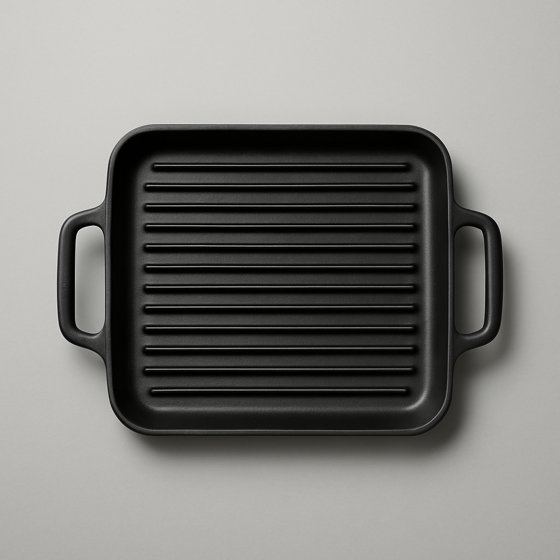
The second reason is thermal behavior. A casting has high mass; it takes up heat slowly and holds it for a long time. The enamel layer gives this mass a surface that withstands scratching, high temperature and color fading. Casseroles, cast iron grill pans and wood stove bodies are coated on the same logic: parts that work for years under direct heat and mechanical load.
It is worth remembering that enamel is not a paint. In paint a resin cures; in enamel, glass fuses chemically to the metal. This distinction explains why such high temperatures are needed and why it is brittle. For a broader look at process choices, the what is wet enamel article also explains why the slip method (a water-based frit suspension) is mostly used for castings.
Managing Outgassing
The most common defects on castings are pinholes and blisters, and at their root there is almost always outgassing. Gas trapped in the part's pores and graphite structure rises through the enamel layer, which is still liquid at firing temperature. Gas that cannot escape before the glass cools and solidifies leaves a hole or blister on the surface.
The first step in managing this is pre-annealing. Before enameling, the part is usually passed through an annealing furnace at around 800–900 °C. This step has two jobs: burning off oil, sand and graphite residue from the surface, and driving most of the gas out of the pores before there is any coating. The annealed surface also oxidizes slightly; this thin oxide layer helps the ground coat adhere.
The second step is the firing regime. Ramping up to temperature too fast makes the glass fluid without leaving enough time for the gas to escape. A controlled heating curve lets the gas vent before the enamel fully fuses. Controlled cooling after firing also matters; sudden cooling turns the expansion difference between casting and glass into stress.
Caution
Most outgassing problems start not in the furnace but at the casting and cleaning stage. Molding sand residue, machining oil or incomplete annealing defeat even the best firing curve. Keep the surface dry, clean and annealed before it goes to coating.
The application method also affects gas behavior. With wet enamel the slip is laid on the part by dipping or flow coating and then dried; during drying, steam from the water must also escape in a controlled way. An insufficiently dried coat generates extra vapor pressure in the furnace. For symptom-cause matching of these defects, the diagnostic table in the enamel coating defects article is a good reference.
Ground Coat + Cover Coat
Cast iron is generally not finished in a single coat. The classic approach is two coats: first a ground coat, then a cover coat on top.
The ground coat's job is adhesion. It contains additives such as cobalt and nickel oxide, which form a strong bond between metal and ground coat during firing. The ground coat is not decorative on its own and usually looks dark gray or bluish-black. The cover coat is the layer that provides color, gloss and chemical resistance; applied over the ground coat it adheres easily, because the two glass layers fuse together.
| Coat | Task | Typical property |
|---|---|---|
| Ground coat | Adhesion to metal, gas bridge | Cobalt/nickel oxide additives, dark color |
| Cover coat | Color, gloss, chemical resistance | White or colored, food-safe |
How many coats are needed depends on the part. In a casserole whose inner surface is in direct contact with food, both a ground coat and a cover coat are expected; some systems fire each coat separately, others work with a modern two-coat, one-fire (2C1F) setup. A thick enamel applied in one pass builds up internal stress during drying and firing, so it is more prone to chipping; two thin coats often give a sounder result than one thick coat. The exact number of coats and frit recipe are confirmed by the part and the enamel manufacturer's technical datasheet.
Tip
Rather than trying to hide the ground coat color under the cover coat, it is more economical to keep the ground coat thin and even and choose a cover coat with high hiding power. Applying the ground coat too thick lengthens the gas escape path and increases the risk of pinholes.
Thermal Shock
Enamel's best-known weak point is brittleness. Glass does not flex; under a sudden temperature difference or a hard impact it cracks or chips. Thermal shock is the most common scenario that triggers this: plunging a hot cast iron pan into cold water, or heating an empty enamel pot dry over high heat.
The root cause is the difference in thermal expansion coefficients between cast iron and vitreous enamel. When the temperature changes quickly, the two materials expand at different rates; when the stress building up at the interface exceeds what the glass can bear, a crack starts. That is why enamel recipes are adjusted so that their expansion behavior is as close as possible to the underlying metal. Ground coat–cover coat compatibility also comes into play here: the expansion of the two coats should be close to each other.
Use over an open flame requires particular care. The base where the burner flame touches directly can overheat locally; keeping the flame within the diameter of the base and heating on medium lowers local stress. On the user side, a few simple rules greatly reduce the risk:
- Do not heat an empty enamel pot over high heat; dry heating raises the local temperature quickly.
- Let a hot piece cool somewhat before dipping it in cold water.
- Adjust the flame so it does not exceed the base diameter; flame spilling over the edge creates uneven expansion in the body.
- Protect edges and corners against impact; enamel chips most often at the edges.
Design has a share too. Sharp corners and abrupt section changes are stress concentration points both in firing and in use; smoothed transitions extend the life of the enamel. For examples of which product groups castings are used in and with which coating setup, see the cookware solutions page.
In short, cast iron enameling is about holding three balances at once: getting the gas out in time, bonding the two coats firmly to each other and to the metal, and managing the expansion difference through both recipe and design. When these three fall into place, enameled cast iron works for decades without maintenance.
Frequently Asked Questions
Bare cast iron rusts and needs regular seasoning. Enamel provides a pore-free glassy surface that gives resistance to acids and alkalis, hygiene and color permanence; the part becomes washable with detergent.
Before enameling, the part is annealed at around 800–900 °C to remove gas from the pores and surface residue. A controlled heating curve and good drying then let the gas vent before the enamel fully fuses.
Cast iron is generally coated with two coats: a ground coat that provides adhesion to the metal and a cover coat that provides color and chemical resistance. The exact number of coats and recipe are determined by the part and the enamel manufacturer's technical datasheet.