In Short
- With standard powder, recovery efficiency reaches up to 95%; with powders high in sub-10 µm fines, it drops to ~85%.
- A monocyclone suits fast color change and high efficiency; a cartridge/filter booth suits capturing fine powder and single-color series production.
- If you change colors 3 or more times a day, a cyclone or a quick-clean booth is the main criterion that drives the decision.
- Recovered powder must be blended with virgin powder in proportion; fines buildup reduces film quality.
In powder coating, the real money is lost not in the curing oven but on the booth floor. The first-pass transfer efficiency of powder leaving a gun is often in the 60–70% band; the rest misses the part and falls into the booth. The recovery system collects this powder, sieves it and puts it back into use. On a well-set-up line, overall utilization can reach up to 95%, meaning discarded powder drops to 5%. Make a poor choice, and either your powder waste goes up or the line stands still for hours at every color change.
The decision comes down to two recovery approaches: the monocyclone and the cartridge (filter) booth. They do not do the same job, nor can one fully replace the other. Which is right depends almost entirely on how many colors, what kind of powder and what volume you work with.
Why Recovery Matters
The biggest economic advantage of powder coating over liquid paint is that the material that misses does not become trash. In liquid painting, overspray is direct waste; in powder coating, the same overspray can be collected and fed back to the gun. That is why recovery is not an accessory of the line but the center of the cost calculation.
In numbers, the difference is clear. In an application with 65% transfer efficiency, running without recovery means throwing away 35 kg of every 100 kg of powder. When good recovery is added on the same line, waste drops to as little as 5%. Multiply by the powder cost per kilogram and your monthly consumption, and it becomes clear how quickly the system pays for itself. The solvent-free structure we discussed in the what is powder coating article is the main reason powder can be reused without degrading.
But a word of caution: recovered powder is not identical to virgin powder. With each cycle, the particle size distribution becomes somewhat finer, because coarse particles adhere more easily to the part and leave the system, while fine particles stay suspended in the air and return to recovery. That is why recovered powder is used blended with virgin powder in a set ratio (20–30% recovered in most applications).
Monocyclone
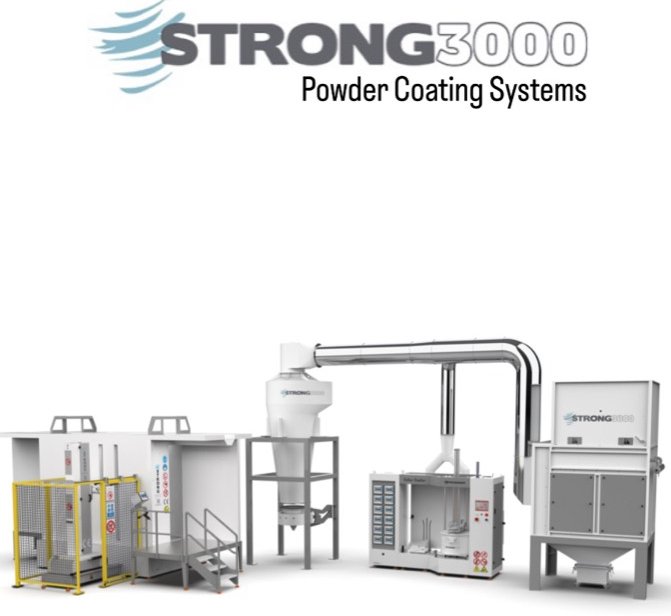
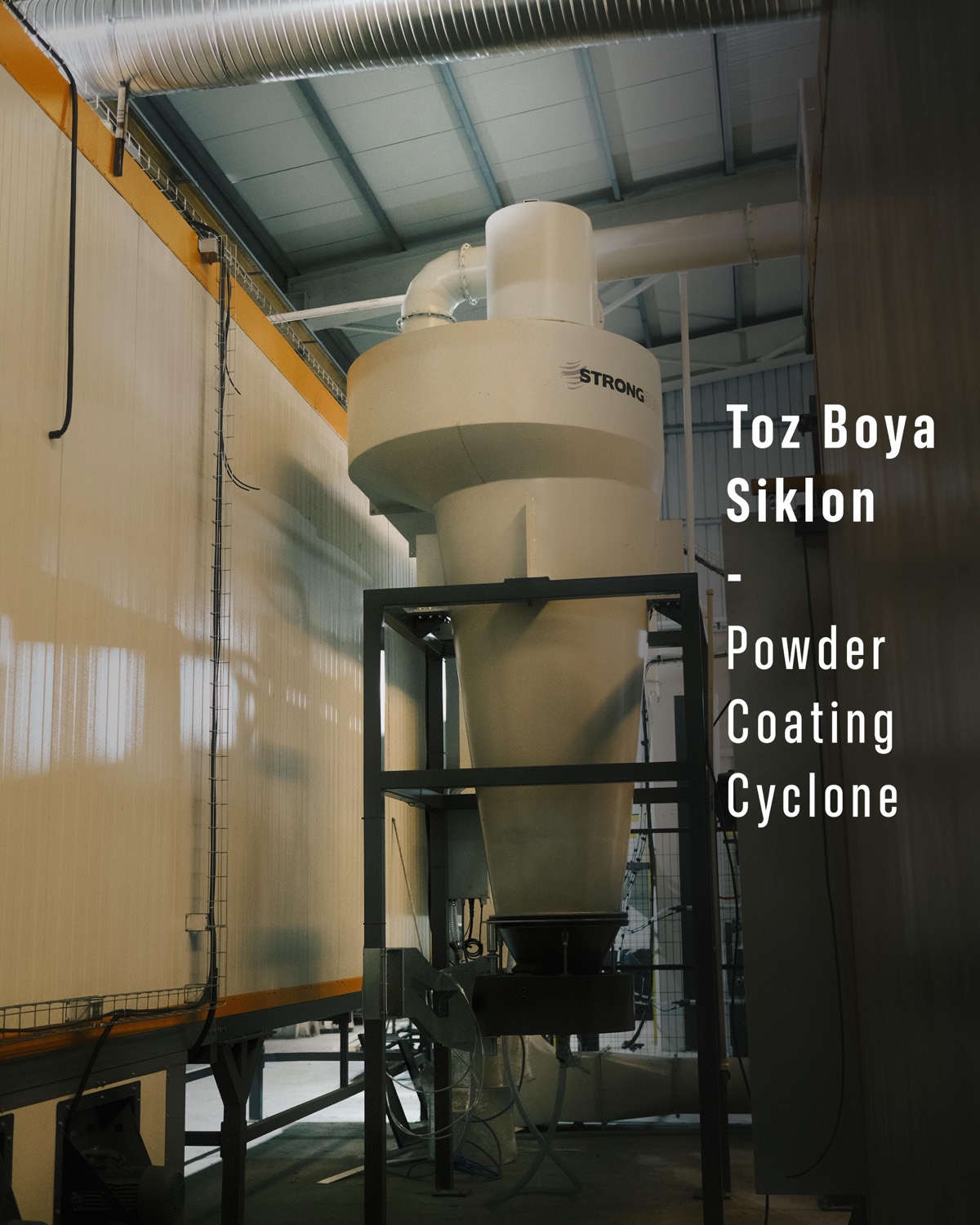
A cyclone is a vessel that mechanically separates powder from air. Powder-laden air enters the cyclone tangentially and spirals downward; centrifugal force throws the heavy particles against the outer wall, from where they drop into the collection hopper. The cleaned air exits at the top and goes to the final safety filter. A “mono” cyclone is the type that works with a single cyclone body.
The real gain of a cyclone is color change speed. Because there is no permanent cartridge filter in the system, there is no large filter surface to remove and clean when changing colors. The cyclone body, hopper and ducts are cleaned; in many designs these surfaces are quickly purged with compressed air and sweeping. In a shop that changes colors many times a day, this means hours gained every day.
The trade-off lies in fine powder. Centrifugal separation is very effective for coarse and medium particles, but it cannot capture some of the very fine particles below 10 µm; these are carried by the airflow to the final filter and in practice are lost to recovery. With standard, coarse-grained powder, this loss is insignificant and efficiency approaches 95%. With metallic or special powders high in fines, however, recovery efficiency can drop to around ~85%.
Tip
Even monocyclone systems have a cartridge “safety/final filter” at the very end of the line. This filter captures the fine powder the cyclone misses and the final clean air; it complements the cyclone rather than competing with it. Powder collected from this filter is generally not returned to use.
Filter / Cartridge Booth
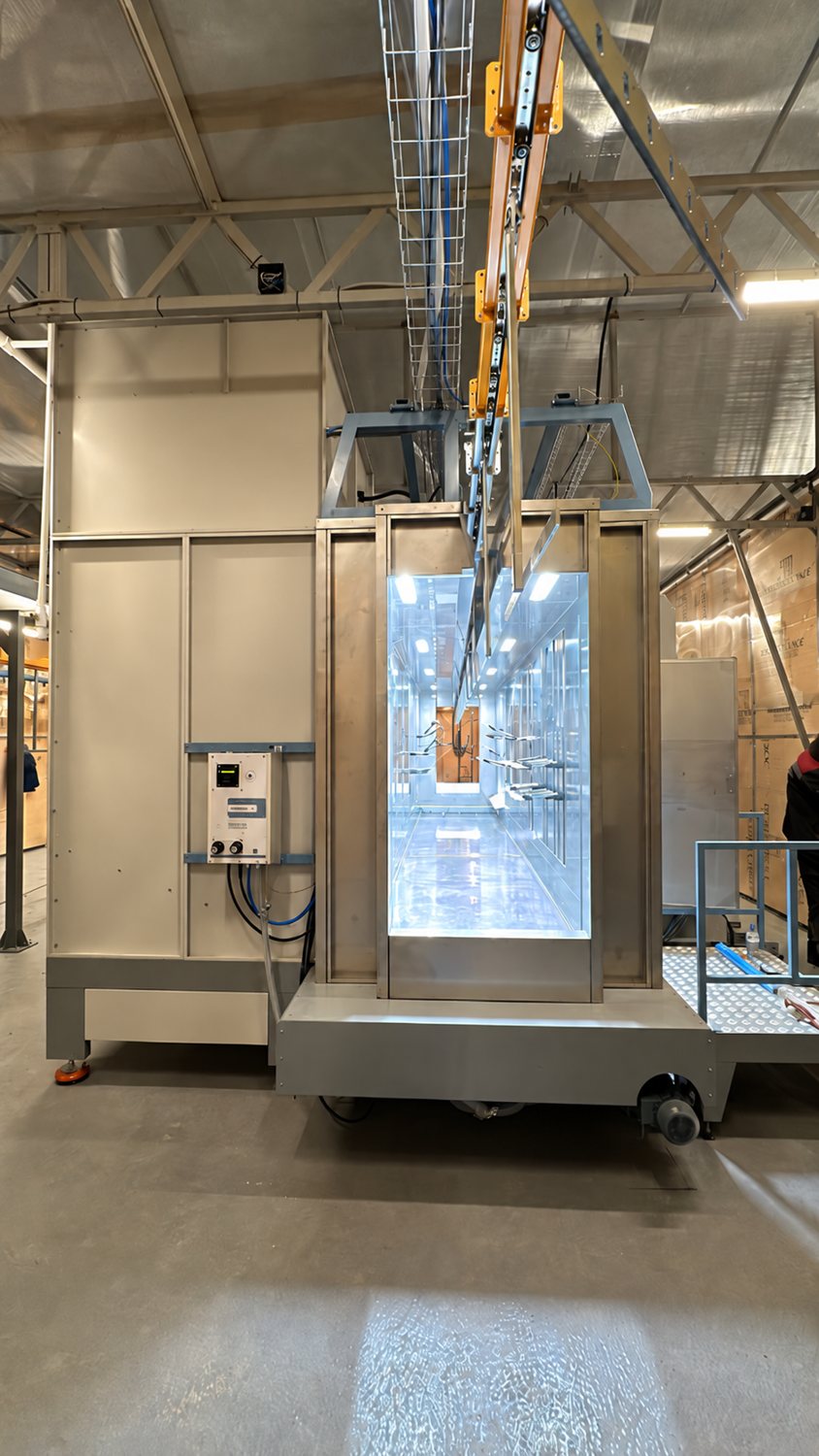
In a cartridge booth, powder-laden air is held on the outer surface of porous cartridge filters. Powder accumulating on the filter surface is shaken off by periodic reverse air pulses (jet-pulse), drops into the collection hopper below and is taken from there for recovery. Because the cartridge also holds very fine particles on its surface, fine powder loss is markedly lower than with a cyclone.
That is why a cartridge booth delivers higher recovery with powders high in fines or in jobs where micron losses are not acceptable. It is usually the natural choice for a line running long series in a single color or a few colors: the filter area is large, airflow is stable, and fine powder is kept in the system.
Its weak point is color change. Cartridges are powder-saturated surfaces; to change colors, you either have to dedicate cartridges to that color (a separate cartridge set for each color) or carry out a long, meticulous cleaning. Fine powder embedded in the media is hard to remove completely and carries a risk of contaminating the next color. That is why a cartridge booth slows the line down in multi-color, frequently changing production.
Color Change
The real distinction between the two systems comes down to one question: how often does the color change? A color change means both line downtime and contamination risk; booth design directly determines this time.
There are also ways to shorten color change time that are independent of the booth type: booths with easy-to-clean PVC surfaces, automatic cleaning cycles, cartridge sets dedicated to each color. Reading this together with our fast color change article, which covers this side in detail, puts booth selection on a numerical footing. As a rough rule: if you change colors 3 or more times a day, it is generally more profitable to give up a little recovery efficiency and go for a cyclone or a quick-clean booth.
Fine Powder (<10 µm)
Fine powder is the technical heart of the recovery debate. With each recovery cycle, the particle distribution shifts a little further toward the fine end. The better the system holds fine powder, the more of it you recover, but at the same time the proportion of fines keeps building up. Beyond a certain point, a mix loaded with very fine powder degrades flowability, charging behavior and film quality: gun output becomes erratic, the film does not cover evenly and the tendency toward orange peel increases.
So the point is not to “recover every particle” but to maintain balance. A cartridge booth holds fine powder well; that is an advantage, but you need to set your virgin powder feed ratio correctly to manage the accumulating fines. A cyclone, on the other hand, already discards the finest fraction from the system; that is an efficiency loss, but it keeps the mix somewhat in balance on its own. It is helpful to read about the effect of excessive fines on the film together with the orange peel and coverage problems in the powder coating defects article.
Caution
The efficiency figures here (95% / ~85%) vary with the powder’s particle distribution, air flow rate and booth design. The exact efficiency is established by measurement with your own powder on your own line; the powder manufacturer’s technical data sheet (TDS) is the first source to consult for particle characteristics.
Booth Selection Guide
Choosing the right recovery is not about finding a single “best” piece of equipment; it is about mapping your own production profile onto a few clear questions. The table below puts the two approaches side by side.
| Criterion | Monocyclone | Cartridge / Filter Booth |
|---|---|---|
| Color change speed | Very fast; no permanent filter | Slow; requires cartridge cleaning/dedication |
| Recovery efficiency (standard powder) | Up to 95% | Up to 95% |
| Fine powder (<10 µm) capture | Weak; the fine fraction escapes to the final filter | Strong; holds fine powder on the surface |
| Efficiency with high-fines / metallic powder | Can drop to ~85% | Stays higher |
| Color contamination risk | Low | High (if cleaning is incomplete) |
| Best use | Many colors per day, frequent changes | Single/few colors, long runs, fine powder |
The questions that clarify the choice:
- How many colors per day? 3 or more regular color changes favor a cyclone or a quick-clean booth. In single-color work, a cartridge booth wins easily.
- What type of powder? With standard polyester/epoxy powders, both systems deliver high efficiency. With metallic or high-fines special powders, a cartridge booth loses less.
- Volume and continuity? In long, uninterrupted runs, the cartridge’s large filter area and stable airflow are an advantage.
- How critical is color cleanliness? When switching from light to dark colors, even the slightest contamination is noticeable; in such production with frequent color changes, a cyclone reduces the risk.
This decision must be made together with the booth body material (PVC, stainless), the level of automation and part size; the booth selection article, which evaluates all of these together, provides a good checklist for the next step. If you want to see how the booth and recovery are positioned as a whole, looking at their place within an end-to-end powder coating line completes the picture.
In the end, both are mature, reliable solutions. A wrong choice usually stems not from bad equipment but from a mismatch with the production profile: putting a cartridge booth in a multi-color shop and forcing an expensive cyclone onto single-color series production are both money spent in the wrong place. Ask the right question from the start, and the booth chooses itself.
Frequently Asked Questions
Yes, powder collected in the booth is sieved and reused blended with virgin powder in a set ratio (20–30% recovered in most applications). Used on its own, without a set ratio, it reduces film quality because of fines buildup.
If you change colors many times a day, a quick-clean monocyclone is more suitable; for long single/few-color runs and high-fines powder, a cartridge filter booth is. The decision depends on the production profile, especially the number of colors per day.
With standard, coarse-grained powder, overall utilization can reach up to 95%. With metallic or special powders high in sub-10 µm fines, especially with a monocyclone, efficiency can drop to around ~85%. The exact value is established by measurement with your own powder and line.