In Short
- Powder coating is a solvent-free thermoset powder blend; there are no VOC emissions.
- The powder clings to the grounded part through electrostatic charge (60–100 kV corona or tribo).
- Curing is measured by part temperature (PMT), not oven air; for polyester, 10–20 min at 180–200 °C.
- When powder that does not adhere is sieved and reused, efficiency reaches up to 95%.
If you coat a part with wet paint and wait for it to dry while the powder coating line next to you turns out a second part within minutes, the difference becomes obvious. Both protect the surface, but the physical mechanism of powder coating is different from start to finish: no solvent, no drying; the film forms through melting and a chemical reaction. Below I cover each step of this process, with numbers that show how it works on the factory floor.
What Is Powder Coating
Powder coating is a finely ground solid thermoset blend. It contains resin (mostly epoxy or polyester), hardener, pigment and flow/surface-control additives. Unlike wet paint, it has no carrier solvent, so volatile organic compound (VOC) emissions are practically close to zero. Particle size is typically in the 25–45 micron range, and this distribution directly affects both charging and film smoothness.
Being “thermoset” is critical. Once the powder has melted, it cannot be reliquefied by reheating, because heat forms a permanent network. This is why the cured film is resistant to solvents and heat. The rough logic is this: the powder first adheres to the part physically, then in the oven it first melts and then hardens chemically.
Knowing the function of the powder’s three basic components makes most problems encountered in the field easier to read. Resin and hardener build the backbone of the film and determine its durability. Pigment provides color and hiding power; a high pigment content is good for hiding but can reduce flow and increase orange peel. Additives manage flow, degassing and surface smoothness. This formulation difference is usually why two different powders with the same RAL code do not look the same.
How Electrostatic Application Works
What holds the powder particles to the part is not gravity but electrostatic attraction. Two methods are common:
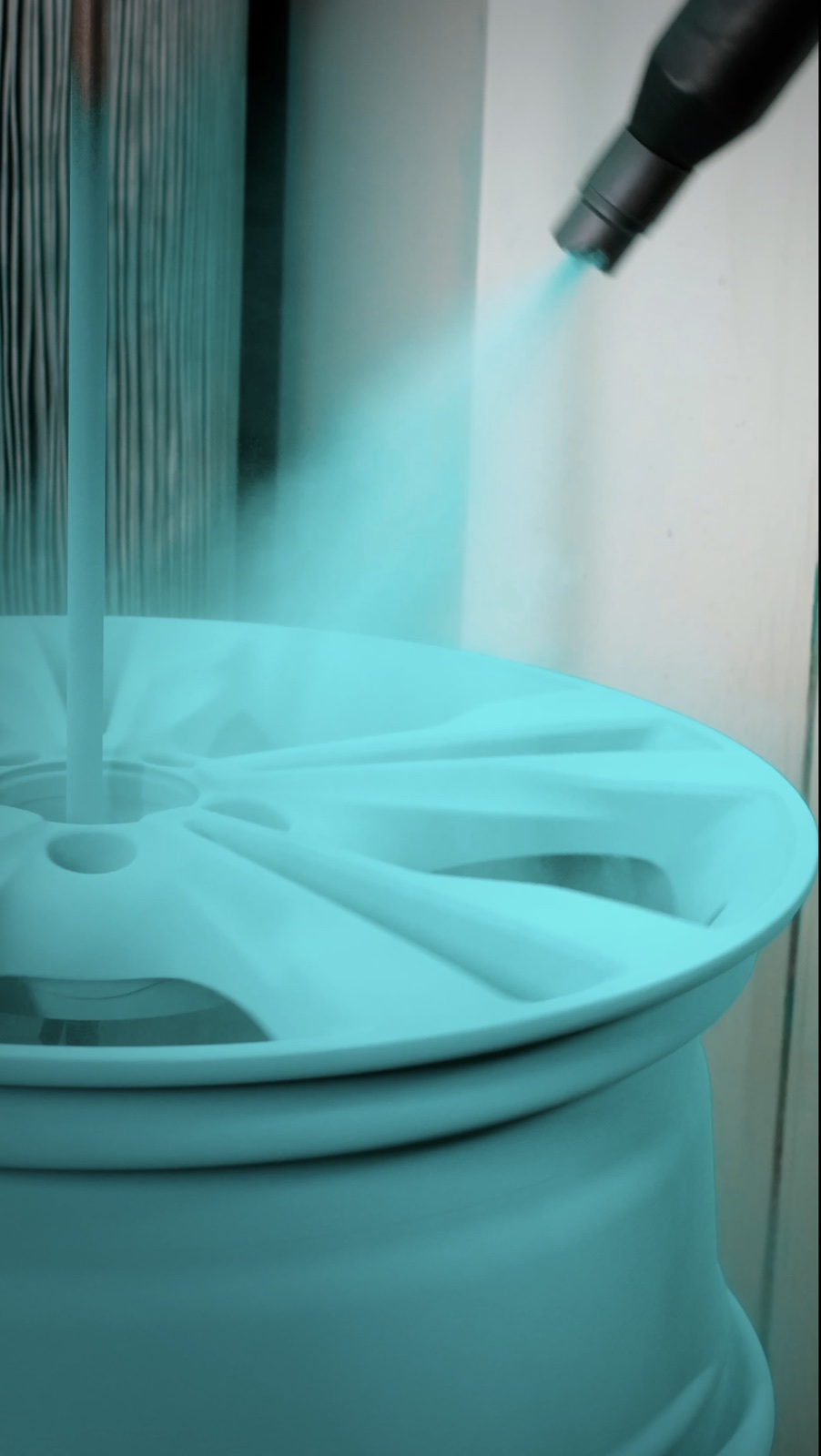
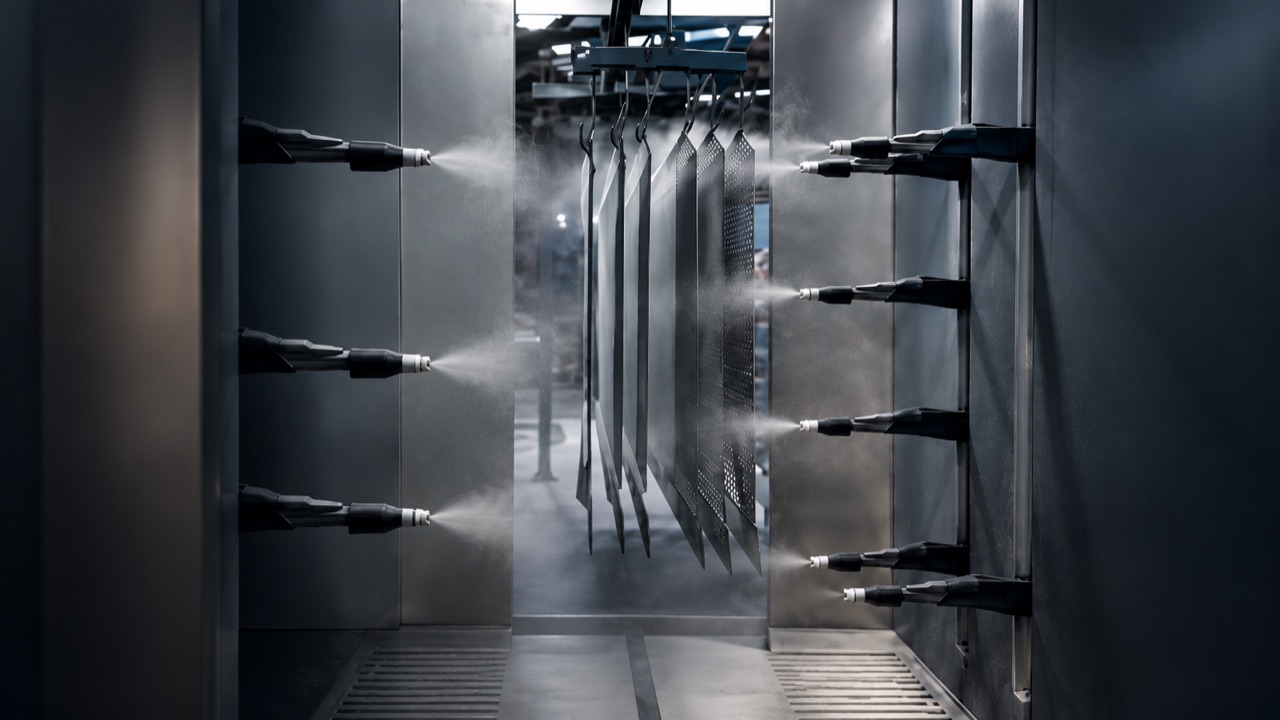
- Corona charging: 60–100 kV is applied to the electrode at the gun tip. This ionizes air molecules, and the free ions give the powder particles a negative charge. Because the part is grounded, the charged powder is attracted to the surface.
- Tribo charging: The powder is charged by friction as it travels along a tube (usually PTFE) inside the gun. No free ions are generated. It gives a more even distribution on concave and deep geometries, but the powder formulation must be tribo-compatible.
The charged powder follows the electric field lines toward the grounded part and also wraps partly around to the back of the part; this is called wrap-around. Wrap-around coats hidden surfaces to some extent, but it is not sufficient on its own; critical areas must be targeted directly.
Caution
Faraday cage effect: charged particles have difficulty entering corners, recesses and concave areas because the field lines gather at the edges. The fix is to lower kV and current (µA), adjust gun distance/angle, and use a tribo gun or a robotic/intelligent motion gun. We cover the root causes of this in the field separately in the powder coating defects article.
Curing: Melting and Cross-Linking
When the part enters the oven, two stages run back to back. First the powder melts and flows to form a continuous film; then the reaction between resin and hardener begins and a cross-linked network is built. This second stage makes the film permanent.
The most common mistake is to take oven air temperature as the measure of cure. What is decisive is the part’s own temperature, known as part metal temperature (PMT, peak metal temperature). Time starts counting after the part reaches target temperature. A thick cast part and 0.8 mm sheet reach target at very different times in the same oven.
| Resin type | Typical PMT range | Hold time at target |
|---|---|---|
| Epoxy | 150–180 °C | 10–20 min |
| Epoxy-polyester hybrid | 160–190 °C | 10–20 min |
| Polyester (TGIC / TGIC-free) | 180–200 °C | 10–20 min |
| Polyurethane / acrylic | 180–220 °C | 10–20 min |
Practical reference: about 10–15 min at 200 °C and about 20–25 min at 180 °C. Exact values are always given on the powder manufacturer’s technical datasheet (TDS) and are confirmed by on-site measurement as part geometry and oven load change. We cover oven curves and PMT measurement in detail in the oven temperature and curing article.
Powder Coating Types
Resin chemistry determines where a powder is used. The four most common groups:
- Epoxy: High chemical and mechanical resistance, for indoor use. Outdoors under UV it chalks, i.e. its color and gloss fade.
- Polyester: Resistant to UV and weathering, the standard choice for outdoor use. Applications such as architectural facades, garden furniture and poles.
- Epoxy-polyester hybrid: Indoor use, economical. Common in radiators, white goods housings and office furniture.
- Polyurethane: Thin, smooth film, good outdoor durability and chemical resistance; generally requires a higher PMT.
Super-durable polyesters and Qualicoat-class products are used on architectural facades. TGIC-free polyesters are becoming increasingly widespread for occupational safety reasons. Color is not the only criterion when choosing: curing temperature, outdoor durability expectations and gloss class are assessed together. For example, a hybrid is economical and sufficient for a sheet metal cabinet that will stay indoors; if the same cabinet will be used outdoors, you need to switch to polyester, otherwise fading and chalking will appear within a few seasons.
Why Pretreatment Is Critical
The most frequently overlooked side of powder coating is not the gun but the surface before the powder. Adhesion and corrosion resistance are determined here. A typical line sequence:
- Degreasing: Oil, grease and dirt are removed from the surface. If residue remains, craters and loss of adhesion are inevitable.
- Conversion coating: Iron/zinc phosphate or nano-ceramic. This layer, which bonds chemically to the metal, increases both adhesion and corrosion resistance.
- Rinsing and drying: Chemical residues are removed and the surface is dried completely.
Nano-ceramic treatments operate at lower temperatures and produce less waste; in architecture, hexavalent chromium chromates are giving way to chromate-free systems. Another insidious source is compressed air from the line: the oil and moisture in it show up as craters in the cured film.
Tip
The cross-cut test (ISO 2409 / ASTM D3359) is a quick and inexpensive way to measure adhesion quality. For corrosion, salt spray (ASTM B117) is assessed along a scribe line; however, the correlation of laboratory hours with real field life is limited, so it should not be read as a lifetime guarantee on its own.
Recovery and Efficiency
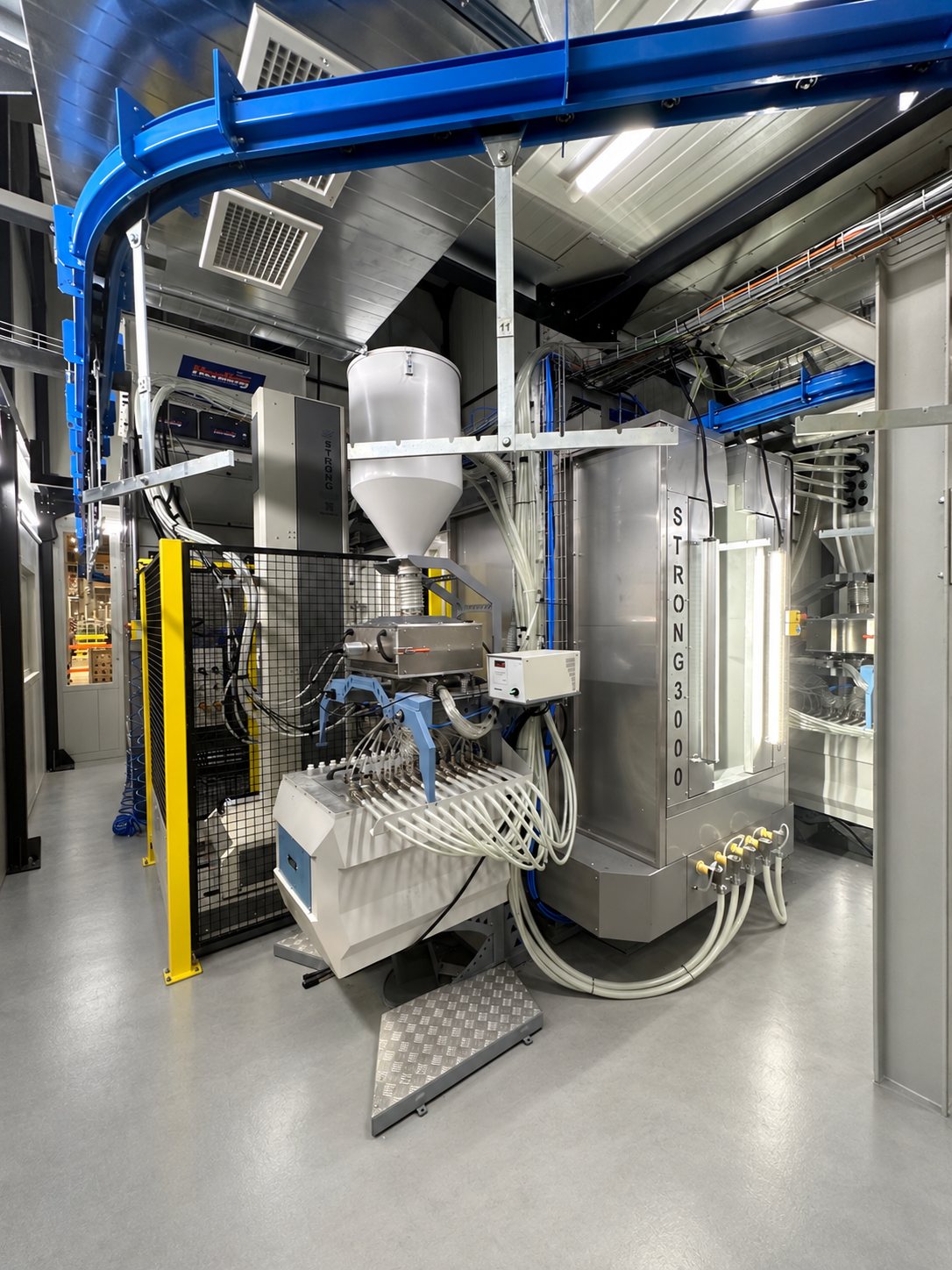
Powder that does not adhere to the part is not lost. The booth extracts the non-adhering powder; a cyclone or cartridge filter collects it, it is passed through a sieve and put back into use. This is where powder coating’s biggest cost advantage comes from.
With standard powder, recovery efficiency can reach up to 95%. With powders high in fines below 10 microns, this drops to ~85%, because very fine powder gets trapped in the filter and degrades film quality when reused. That is why reclaimed powder is blended with virgin powder in proportion (e.g. 20–30%) and fines are not allowed to build up.
Putting efficiency into numbers makes it concrete: on a line spraying roughly 100 kg of powder, most of the powder that does not land on the part in the first pass is collected and sieved. In a well-tuned system, final material utilization exceeds 90%; doing the same job with wet paint, losses are much higher due to solvent evaporation and overspray. With color changes, the logic is reversed: the more often colors are changed, the more cleaning time matters, and cycle time becomes decisive before efficiency.
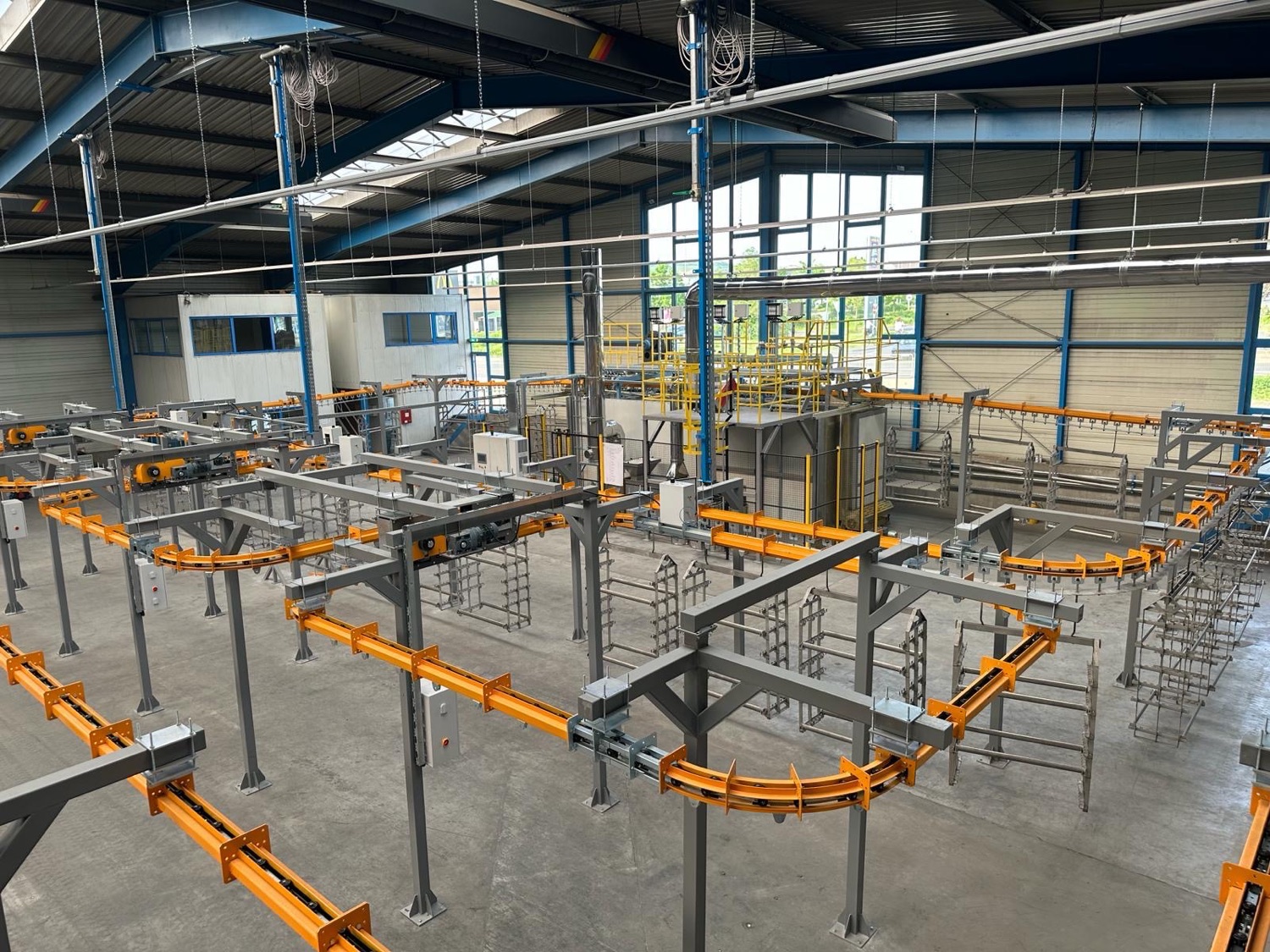
Booth selection depends on color change frequency: on lines with 3 or more color changes a day, quick-clean monocyclone or PVC booths are preferred; cartridge/filter systems capture fine powder better. We compare cyclone and filter options in the powder recovery article. This choice should be made from the start when designing the line as a whole; in a turnkey powder coating line setup, the booth, oven and pretreatment are sized together.
Advantages of Powder Coating
The concrete points that set powder coating apart from wet paint:
- Thick, even film in a single coat: Typically 60–90 microns is achieved in a single application; 60–80 microns is targeted for decorative work. With wet paint, reaching this thickness often requires more than one coat.
- Mechanical and chemical resistance: The cross-linked film withstands scratches, impact and solvents better than a wet film.
- Low waste: With recovery, material loss is minimized; since there is no solvent evaporation, most of the solids stay on the part.
- Environment and occupational safety: No VOCs; flammable solvent storage and wastewater load are significantly reduced.
There are limits too: for very thin, smooth decorative films or for substrates with low heat tolerance (such as plastics), wet systems may still be preferred, because the curing temperature is too high for some materials. The right choice is assessed together with the part’s material, geometry and service environment.
Frequently Asked Questions
Generally 60–80 microns is targeted for decorative work and 60–90 microns for general applications. Excessive thickness increases the risk of orange peel and sagging; insufficient thickness creates weak hiding and corrosion protection.
It depends on the resin: epoxy 150–180 °C, polyester 180–200 °C, hybrid 160–190 °C, polyurethane 180–220 °C. Time is counted as 10–20 min after the part reaches target temperature (PMT). The exact value is given in the powder’s TDS.
In the same application, the cross-linked film of powder coating generally withstands scratches, impact and solvents better and gives 60–90 microns of thickness in a single coat. Wet systems may still be preferred for heat-sensitive or very thin decorative work.
Polyester and polyurethane powders are resistant to UV and outdoor weathering. Epoxy, however, chalks under UV, so it is not used outdoors; polyester-based powders are chosen for exterior applications.