In Short
- A manual gun is the most flexible solution for variable parts and low volumes; it stays sensible up to a few hundred parts per day.
- An automatic reciprocator coats the same part at the same film thickness throughout the shift; it calls for repeatability, not variability.
- Robotic application comes in for complex geometry, but it brings an investment and programming burden.
- Most real lines are not a single solution: automatic main coating + manual touch-up.
The most debated question when setting up a line is: should a person hold the gun, or a machine? The answer depends less on part count than on part variety. A shop coating 40 different part numbers a day and a factory coating 3,000 identical enclosure bodies understand the same word (automation) very differently. Below, I separate the three approaches on concrete axes such as film thickness, transfer efficiency and commissioning time.
Manual Application
The strength of a manual gun lies in the operator's eye. Even if part geometry changes every time, the person instantly adjusts distance, angle and trigger time. Approaching a recessed corner and lowering kV, or backing off on a flat surface for wide passes, is a reflex for a human. That is why manual is still the fastest route for samples, prototypes and small batches; you don't stop the line to write a program.
The settings of a manual station are also simple and are adjusted by hand to field conditions: typically 60-90 kV output, a gun-to-part distance of a few hundred millimeters and a powder output of a few hundred grams per minute. The operator measures film thickness and rebalances these values for each part number. This freedom is a real advantage for job shops whose product mix keeps changing; nobody has to deal with reciprocator strokes.
The limitation comes from the same place. Even if the 60-90 µm film thickness target is hit in manual application, a deviation of 15-25 µm between two points on the same part or between two shifts is normal. This deviation both increases powder consumption and leaves a corrosion weakness in thin areas on outdoor parts. Transfer efficiency varies by operator; around 60-70% with an experienced person, it drops noticeably on a tired or rushed shift. A manual line's capacity is also physical: one person can only work through a certain number of hangers per hour.
Tip
You cannot defend consistency in manual application without measuring it. Measure magnetic film thickness (DFT) on a few parts per shift and keep records; if the deviation grows, the problem is usually not the gun but grounding and hanger contact or air pressure.
Automatic / Reciprocator
In automatic application, guns are mounted on a reciprocator moving up and down on one axis (usually vertical); the part passes in front of them on a conveyor. The system does not recognize the part; it simply sprays powder at the programmed stroke and speed. That is why the automatic solution shines under one condition: when part geometry and conveyor speed are constant.
In return, the gain is substantial. With the same resin, the same part stays in the 65-75 µm band from the first hanger to the last; operator fatigue drops out of the equation. With many fixed guns, total output capacity is taken far above manual. When coating thousands of meters of a polyester exterior profile, this repeatability is decisive for both UV resistance and warranty.
You pay the price when the part changes. When switching to a new part number, stroke height, number of guns, kV and conveyor speed have to be readjusted. With a small number of products, this initial setup is done once and forgotten; on a line where dozens of part numbers change every day, constant readjustment takes back the time automation saved.
The second hidden cost of an automatic station is color change. As the number of fixed guns increases, so does the surface to be cleaned; that is why, on automatic lines running many colors, booth and recovery selection is an integral part of the decision. On a line switching between more than three colors a day, without a quick-clean booth and monocyclone recovery, automation's speed gain melts away between color changes.
Robotics
A robot does what a reciprocator cannot: it moves the gun in three dimensions, following the part's contour. On forms that a reciprocator's straight stroke cannot coat evenly, such as wheel hubs, engine blocks and curved furniture frames, the robot holds the gun at the right distance and angle to every surface. In deep recesses where the Faraday cage effect is strong, it noticeably improves penetration compared with a fixed gun.
A robot's cost is not just the price of the arm. A motion path must be programmed for each new part; this programming can take hours and requires skilled personnel. That is why a robot makes sense either in very high-volume single-type work (you write the program once and run it for years) or in intelligent motion systems that can reposition the gun quickly. For low-variety, medium-volume work, it is often heavier than necessary.
What a robot really gains you is constant distance. When the gun-to-part gap is held constant while following the contour, both film thickness and electrostatic field density stay consistent; this makes it easier to maintain the 65-75 µm band even on a curved surface. A fixed gun cannot maintain this gap as the part moves closer and farther away, so thickness fluctuates. When deciding, it is more accurate to see the robot as a geometry tool rather than a speed tool.
Automatic + Manual Touch-Up
In the field, most real lines use not one of these three options but a combination of two. The typical setup is this: the part first passes in front of the automatic guns, where 85-95% of the surface is coated; immediately afterward, an operator completes the inside corners, hole edges and shadowed surfaces that the reciprocator cannot reach with a manual gun. This takes repeatability from automatic and flexibility from manual.
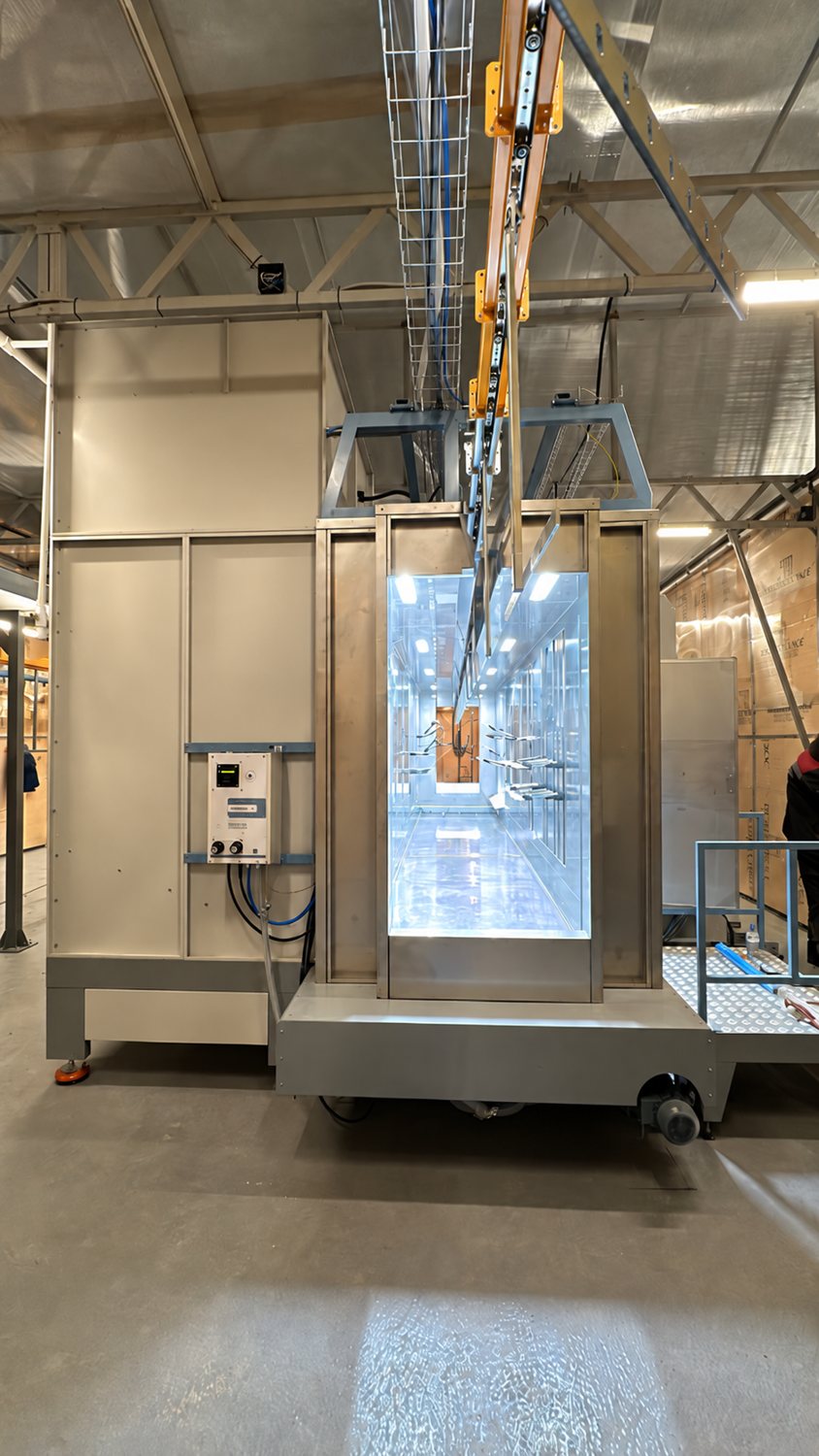
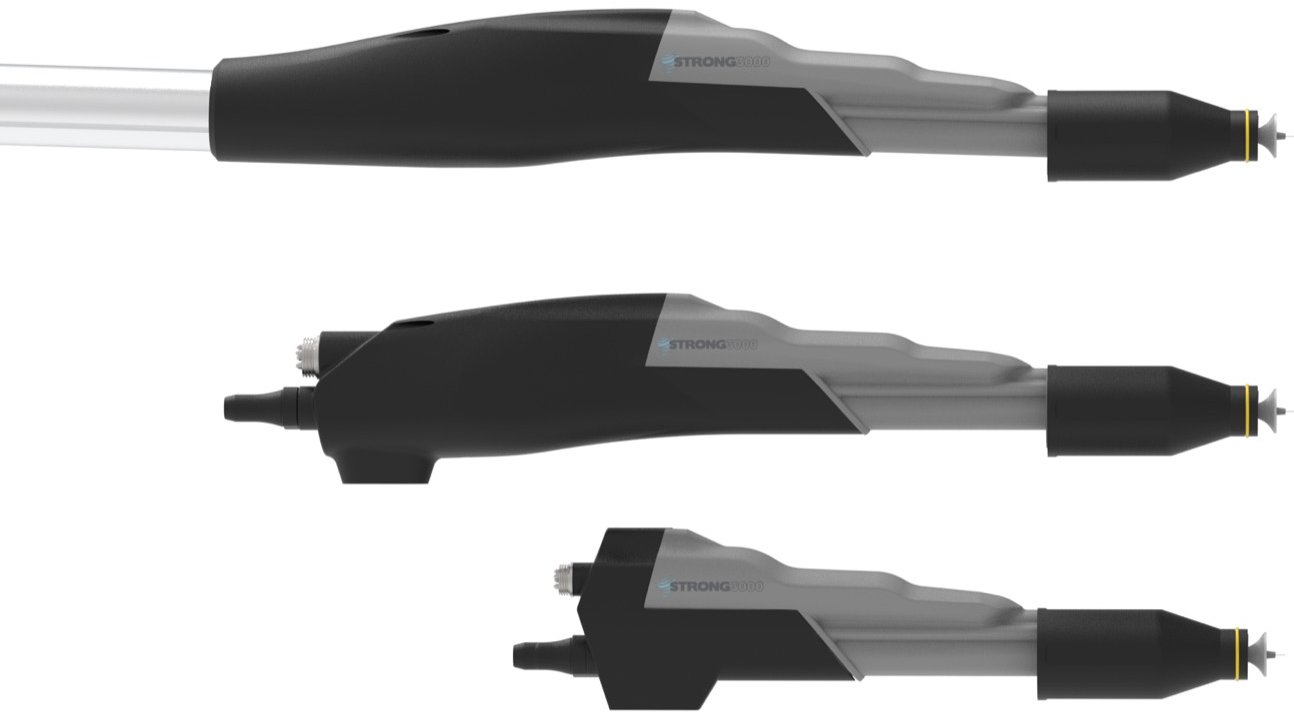
This split becomes especially clear at the application station of a powder coating line: the automatic zone coats the bulk with high efficiency, and the manual station reduces waste and rework. Intelligent motion guns are blurring the line between these two worlds; the goal of combining the repeatability of a fixed reciprocator with the geometry tracking of a robot in a single product is the starting point of approaches like the OWL intelligent motion gun.
Caution
Do not make the “let's automate” decision by looking at part count. What matters is how many different part numbers you coat per day and how complex each one's geometry is. If variety is high, full automation often eats itself up in setup time; a hybrid automatic + manual setup is healthier.
Which One for Which Job
The table below compares the three approaches on the axes you actually look at when deciding. Values are typical field ranges; exact transfer efficiency varies with the part, powder and settings.
| Criterion | Manual | Automatic (reciprocator) | Robotics |
|---|---|---|---|
| Best-suited volume | Low (batch/sample) | High, single type | Very high or complex form |
| Part variety | Very high | Low | Low-medium |
| Film thickness consistency | Operator-dependent, ±15-25 µm | High, narrow band | High, even on contours |
| Transfer efficiency | Variable (~60-70%) | Consistent and high | High, superior in recesses |
| Commissioning / part changeover | Instant | Requires adjustment | Requires programming |
| Initial investment | Low | Medium | High |
| Faraday / deep recess | Solved by operator skill | Weak | Strong |
Three questions are enough to decide: How many different part numbers do I coat per day? Do my parts have deep recesses a reciprocator cannot reach? Do I need to repeat the same part at the same quality across shifts? If you answer “many” to the first question, you lean toward manual or a hybrid setup; if “few and identical,” toward automatic. Complex forms that answer “yes” to the second question bring robots or intelligent motion into the picture. For most mid-sized manufacturers, the right answer is not a single box but a line that completes automatic main coating with manual touch-up.
Frequently Asked Questions
The decision depends more on variety than on part count. If you coat many different part numbers a day, manual or a hybrid setup makes more sense; if you coat a small number of identical parts, automatic does.
For deep-recessed or curved forms that a reciprocator's straight stroke cannot coat evenly, and for very high-volume single-type work. For low-variety, medium-volume work, it is generally heavier than necessary.
Automatic guns coat most of the surface but cannot always catch inside corners, hole edges and shadowed areas. Manual touch-up completes these points and reduces waste.