In Short
- Enameling steel is not ordinary sheet: it is decarburized steel with reduced carbon content that can release its hydrogen.
- Hydrogen trapped in the steel escapes during cooling after 780–850 °C firing and lifts the enamel in crescent shapes; this defect is called fish scaling.
- EN 10209 defines cold-rolled flat products for enameling; the “E” and “K” in grades such as DC04EK indicate suitability for enameling and resistance to fish scaling.
- The right steel choice is not enough on its own; it works together with the frit, the firing regime and surface preparation.
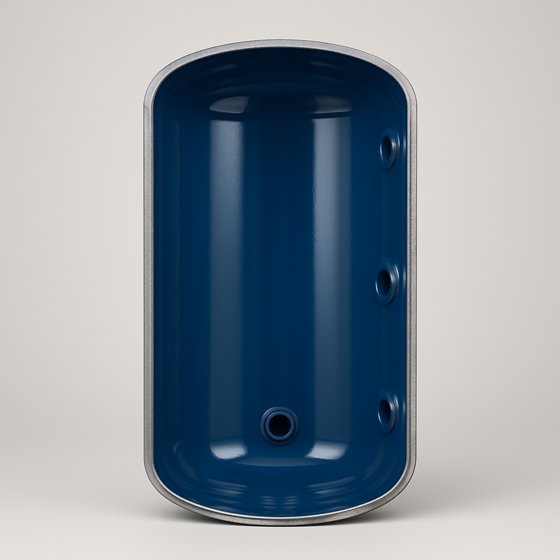
When fish scaling starts appearing on a water heater inner tank line, the first suspects are usually the frit or the furnace. Yet the problem generally sits one step back, in the supplied sheet itself. Enamel is a glassy layer fused onto the metal; if the steel underneath is wrong, even the best frit and the most controlled firing cannot save the surface. That is why the steel grade of a part to be enameled is a decision that must be settled before the coating recipe.
Why a special steel is needed
The bond between enamel and steel is chemical. During firing, the frit partially dissolves the steel surface and fuses with the metal. For this fusion to be sound, the steel's composition and internal structure must stay within a narrow window. Two variables stand out: carbon and hydrogen.
High-carbon steel releases carbon as gas (CO, CO₂) at firing temperature. This gas tries to pass through the still-fluid glass layer; the result is pinholes, blisters and porosity. Carbon also disrupts iron oxide formation and adhesion. That is why carbon content in enameling steel is kept as low as possible; typically below 0.08%, and in grades produced for enameling often targeted in the 0.04–0.05% range.
The second and more insidious problem is hydrogen. Steel picks up hydrogen during acid cleaning (pickling), surface preparation and firing. Where this hydrogen goes depends on which steel you choose. In the wrong steel, hydrogen lifts the enamel as it escapes during cooling; in the right steel it is released in a controlled way. The link between fish scaling and steel selection should be sought in this mechanism, which we also detail on the enamel coating defects side.
What decarburized steel does
Decarburization, as the name suggests, is the controlled removal of carbon from the steel surface. Sheet annealed in a hot furnace in a humid or oxidizing atmosphere gives up its carbon in the near-surface zone. What remains is a ferritic, coarse-grained structure with high gas permeability.
The practical benefit of this coarse-grained ferritic structure is that it contains a large number of grain boundaries and micro-voids. Hydrogen is temporarily held in these voids and, during cooling after firing, released slowly before the glass layer hardens. In other words, decarburized steel does not trap hydrogen and releases it in time; this behavior is the basis of fish scaling resistance.
To draw a contrast: ordinary deep-drawing sheet (for example DC04) forms mechanically very well but is not prepared for enameling. The enameling version of the same family gains this gas management capability through additional processing. The two sheets look identical; their behavior diverges on the way out of the furnace.
Tip
The phrase “enameling sheet” alone on the supplier's certificate is not enough. Separately request the carbon content, the material code (e.g. DC04EK) and a declaration on fish scaling resistance. Grades with and without fish scaling resistance exist side by side under the same standard.
What EN 10209 and DC04EK tell you
The standard referenced for flat steel products to be enameled is EN 10209. It defines the grades, composition limits and mechanical properties of cold-rolled thin sheet and strip intended for enameling. The letters in the material code give direct clues for the process.
Reading the code is the most practical way to order the right sheet:
| Symbol | Meaning | In practice |
|---|---|---|
| DC | Cold-rolled flat product | Thin sheet with a smooth surface; suitable for forming |
| 04 | Formability class (deep drawing) | The higher the number, the deeper the drawing capability |
| E | Suitability for enameling | Composition and surface are controlled for enameling |
| K | Conventional / fish-scale-resistant grade mark | Steel with hydrogen behavior tailored for enameling |
That is why DC04EK is a common starting point: it combines good deep-drawing capability with enameling compatibility. It is frequently chosen for parts that are both formed and enameled, such as water heater inner tanks, oven cavities and cookware. The standard also defines other grades for different forming and gas behavior; if the part geometry requires deep drawing, a higher formability class can be chosen, and for flat surfaces a more economical class.
Standard codes alone do not give you a recipe; which grade suits which part is decided together with the geometry to be produced and the chosen enamel system. Whether the powder enamel process will be single-coat or two-coat also affects steel selection; single-coat, single-fire systems are more sensitive to the gas behavior of the underlying steel.
Hydrogen management and fish scaling
Once you understand the mechanics of fish scaling, it also becomes clear why steel selection matters so much. The process works like this:
- The steel absorbs hydrogen atoms during surface preparation and firing.
- At firing temperature (~780–850 °C for steel) the steel holds hydrogen more easily; the glass layer is fluid.
- Cooling begins. The steel's capacity to dissolve hydrogen drops and the atoms want to escape.
- By this time the glass layer has solidified. The escaping hydrogen builds pressure at the interface and lifts the enamel in a crescent shape.
Decarburized steel breaks this chain at two points. First, the coarse-grained ferritic structure brings hydrogen release forward to before the glass layer solidifies. Second, the micro-voids in the structure act as a “buffer” for hydrogen; instead of a sudden, intense burst of gas, there is a diffuse, harmless release.
Caution
The right steel does not rescue a bad firing regime. Fast, uncontrolled cooling can trap hydrogen and turn it into fish scaling even in the best decarburized sheet. Steel selection, controlled cooling and fish-scale-resistant frit must work together; if one of the three is missing, the risk returns.
In practice, the countermeasures complement each other. When intervening on a line with a history of fish scaling, check the following in order: carbon content and fish scaling resistance declaration on the sheet certificate, pickling time (longer immersion means more hydrogen), cooling rate after firing and, if needed, a post-firing hold/degassing step. On thick-section castings or heavy sheet parts, hydrogen escapes with more difficulty, so the cooling profile becomes even more critical.
When steel selection is done right, the gain is not just a defect-free surface. On parts where freedom from pores is essential, such as water heater inner tanks, fish scaling and pinholes drop at the same time; this directly raises the pass rate in holiday (porosity) testing.
Pre-order checklist
To secure the steel decision, clarifying a few items at the procurement stage is enough:
- Material code and standard: Is it a grade under EN 10209 marked as suitable for enameling (e.g. DC04EK)?
- Carbon content: Is the value declared on the certificate within a reasonable band for enameling?
- Fish scaling resistance: Was the resistant grade under the same standard ordered? State this distinction explicitly.
- Formability class: If the part is deep-drawn, is the drawing capability sufficient?
- Application system: Single-coat or two-coat, powder enamel or wet enamel? The system changes the gas behavior expected from the steel.
Enameling-grade steel is the silent variable that determines coating quality before the furnace door. Exact grade and firing values are confirmed by the part, the frit supplier's technical datasheet (TDS) and field measurements; but the starting point is always choosing the right sheet underneath.
Frequently Asked Questions
Low-carbon, decarburized, fish-scale-resistant enameling steel is used. Grades such as DC04EK under EN 10209 are the typical choice.
It is steel whose surface carbon has been reduced by controlled annealing. Thanks to its coarse-grained ferritic structure, it holds hydrogen and releases it in time after firing.
Largely, yes. Hydrogen trapped in the steel lifts the glass layer in crescent shapes during cooling. The right steel, controlled cooling and resistant frit together prevent this defect.
DC denotes a cold-rolled flat product, 04 the deep-drawing class, E suitability for enameling and K a fish-scale-resistant grade.