In Short
- Wet paint is a liquid coating made of a mixture of resin + solvent (organic solvent or water) + pigment; the film forms through evaporation of the solvent and/or curing of the resin.
- Its main difference from powder coating: it is applied as a liquid, gives a thin film and can dry at low or room temperature, but waste and VOC emissions are high.
- Still the first choice for very large, assembled or heat-sensitive parts and for subtle shade transitions.
- Spray waste, drying time and solvent emissions are the costs wet paint has to carry.
When setting up a coating line, the first distinction usually comes down to this question: will the part go into an oven, and if so, at what temperature? Because wet paint can get around this question, it keeps its place in the field despite the spread of powder coating. When you need to paint a very large steel structure, a fully assembled machine or a substrate that cannot be heated above 60 °C, the options narrow quickly.
What Is Wet Paint
Wet paint (also called liquid paint) is a coating applied in liquid form. It has three main components: the binder resin (the film-forming part), the solvent (the carrier that keeps the resin liquid and applicable) and the pigment (color and hiding power). Fillers and additives (driers, flow modifiers, matting/gloss adjusters) are added to these.
Depending on the solvent, it falls into two broad groups:
- Solvent-based: Organic solvents (thinner, xylene, aromatics) are used as the solvent. It generally gives faster surface drying and good wetting, but VOC (volatile organic compound) emissions are high.
- Water-based: Most of the carrier is water. VOC drops markedly; on the other hand, drying is more sensitive to humidity and temperature, and surface preparation and application discipline are more critical.
Film formation proceeds through one or both of two mechanisms. In some systems, only the solvent evaporates and the resin hardens physically (physical drying). In others, after the solvent evaporates, the resin reacts chemically with atmospheric oxygen or with a hardener and crosslinks (curing). Two-component (2K) polyurethane and epoxy paints belong to this second group; single-component (1K) alkyd paints dry by oxidizing in air.
Tip
You can quickly frame how a wet paint will behave with two questions: “solvent or water?” and “1K or 2K?” The exact drying/curing conditions, mixing ratio and pot life are always given in the paint manufacturer’s technical data sheet (TDS); in the field, this sheet is the reference.
How It Differs from Powder Coating
As the name suggests, powder coating contains no solvent; a dry powder is held to the part electrostatically, then melted and cured in the oven to form a film. Wet paint, by contrast, comes as a liquid together with its solvent. This single difference triggers a chain of differences in process, cost and quality.
To see the most practical distinctions at a glance:
| Criterion | Wet (liquid) paint | Powder coating |
|---|---|---|
| Film formation | Solvent evaporates; physical drying and/or chemical curing | Powder melts, flows and cures in the oven |
| Typical hardening temperature | Room temperature to ~80 °C; 60–80 °C may be enough for force drying | 150–200 °C at part metal temperature (PMT) |
| Typical film thickness (single coat) | ~20–50 µm; thin coats possible | ~60–90 µm; a thin film in a single coat is difficult |
| Number of coats | Primer + topcoat, with an intermediate coat if needed, applied separately | A single coat usually gives sufficient hiding |
| VOC / emissions | High with solvent-based; low with water-based | No solvent; VOC practically negligible |
| Waste / material efficiency | High spray waste; overspray cannot be recovered | With recovery, powder is largely reused |
| Heat-sensitive substrate | Wood, plastics and heat-treated parts can be painted | Not suitable for substrates that cannot withstand oven temperatures |
The difference in thickness is overlooked in most discussions but is decisive. With wet paint, it is easy to lay down a thin, controlled film of 25–30 µm in a single coat; with powder coating, because of its melt and flow behavior, getting a single coat below 60 µm is difficult in practice. On detailed parts requiring a thin film, or when building a multi-layer clear/colored system, this difference works in favor of wet paint.
The process logic is also different. In powder coating, curing is an oven step counted after the part’s metal temperature, not the air temperature, reaches the target. With wet paint, many systems dry at room temperature; even when an oven is used, the aim is usually to speed up drying, and high temperature is not mandatory. If you want to see in more detail how the two processes are positioned, the what is powder coating article covers the powder side.
Where It Is Preferred
The typical cases in which wet paint is still the first option fall under a few headings:
- Very large or assembled structures: Bridge elements, steel structures, large tanks, fully assembled machines. If the part does not fit in a curing oven, powder coating is ruled out from the start; wet paint can be applied on site, even outdoors.
- Heat-sensitive substrates: Wood, MDF, some plastics, modules with embedded electronics, or heat-treated metals that would lose their properties if heated. Anything that cannot go into a 150–200 °C curing oven belongs in this group.
- Subtle shade transitions and special looks: For metallic and pearlescent effects, gradient applications or automotive-style multi-coat painting, wet paint offers more flexible control. The wet film can be finely directed with methods ranging from brush to robot.
- Repair and touch-up: Local repair of a coating damaged in the field, removing scratches after assembly or partial repair of a powder-coated surface is mostly done with wet paint. Re-baking a single part is often neither possible nor economical.
Tip
The decision is usually made not by asking “which is better” but “can this part go into an oven, and what film thickness do I want?” Once part size, substrate type and desired thickness are clear, the choice largely reveals itself.
Limits of Wet Paint
Wet paint is flexible but not free of cost. When designing a line, these limits must be taken into account from the start:
- VOC and emissions: In solvent-based systems, evaporating organic solvents are a major source of emissions. This means both ventilation and exhaust stack systems and legal emission limits. Switching to water-based or high-solids paints reduces this burden but does not eliminate it entirely.
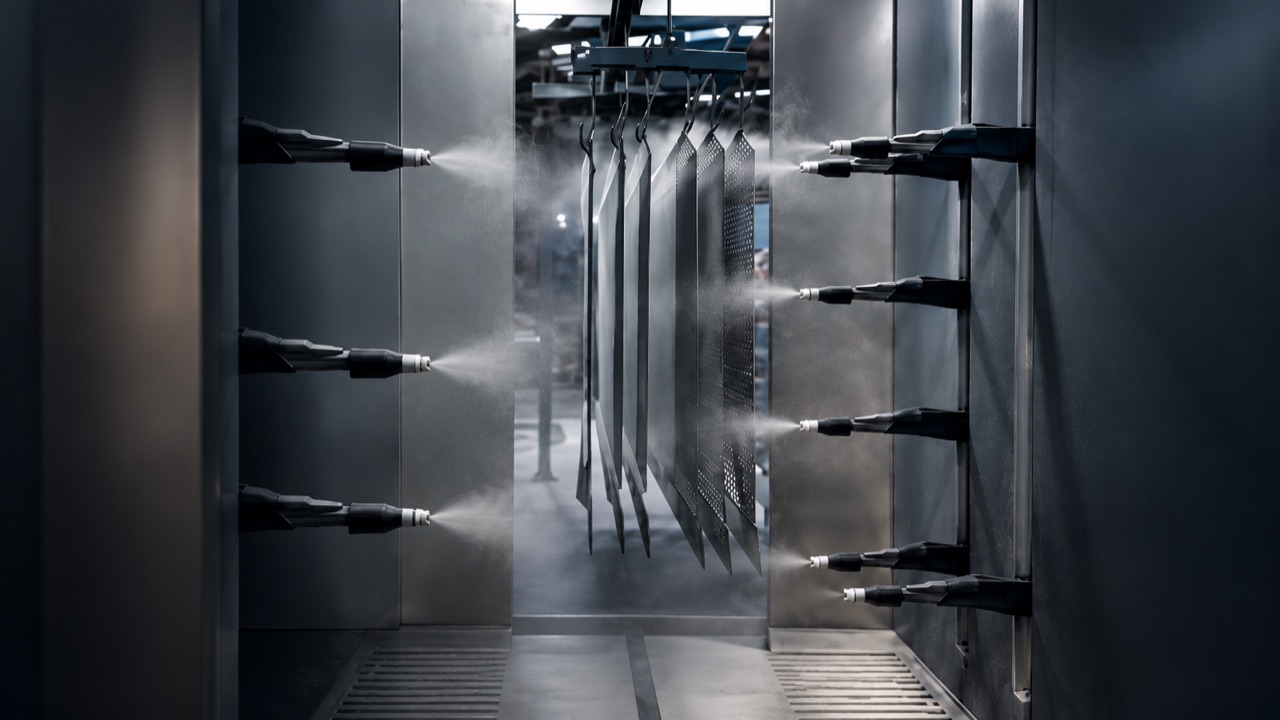
- Spray waste: In spraying, part of the paint goes not to the part but into the booth air (overspray). Unlike powder coating, it cannot be collected and reused; this paint loss is a direct cost. To increase transfer efficiency, HVLP or electrostatic liquid guns and the correct distance and angle are used.
- Drying time: Drying at room temperature is much slower than powder curing, which takes minutes. Dust-free drying can take minutes, touch-dry hours, and full hardening (especially in 2K systems) days. This requires buffer stock and floor space in the production flow.
- Film durability: A thin wet paint film is generally mechanically and chemically weaker than a quality powder film of the same thickness; however, this depends heavily on the system and the number of coats. The right primer + 2K topcoat combination can deliver very durable results.
These limits do not make wet paint a bad choice; they simply show that the choice must be an informed one. If you want to set the two methods side by side for the same part and weigh them on cost, durability and emissions, the powder coating or wet paint comparison breaks down this balance item by item. To understand the powder side from the ground up, you can also go back to the what is powder coating article.
Caution
In solvent-based wet paint, solvent vapors are both flammable and harmful to health. Spray application in an enclosed space must not be carried out without proper ventilation, explosion-proof equipment and personal protective equipment. Exact requirements are stated in the product’s safety data sheet (SDS) and in local regulations.
Frequently Asked Questions
There is no single right answer; it depends on the part. Wet paint comes out ahead for large, assembled or heat-sensitive parts that cannot go into an oven, while powder coating leads in durability and waste for series-produced metal parts that can be oven-cured.
Because it can dry at room temperature, gives a thin film and can be applied to heat-sensitive or very large substrates. In cases such as repair, touch-up and subtle shade transitions, it does what powder coating cannot.
Yes, if the right system is chosen. Outdoor use requires resins resistant to UV and weathering (e.g. 2K polyurethane or acrylic) and a suitable primer; some systems such as alkyds wear faster outdoors. Exact durability is stated in the product’s TDS.