
In Short
- On an ammunition body the job of the coating is to protect against corrosion over a long storage period and to make the ammunition identifiable by colour and markings.
- Wet paint is used for this job because of its thin, controlled film, low-temperature curing and the primer and topcoat systems defined in specifications.
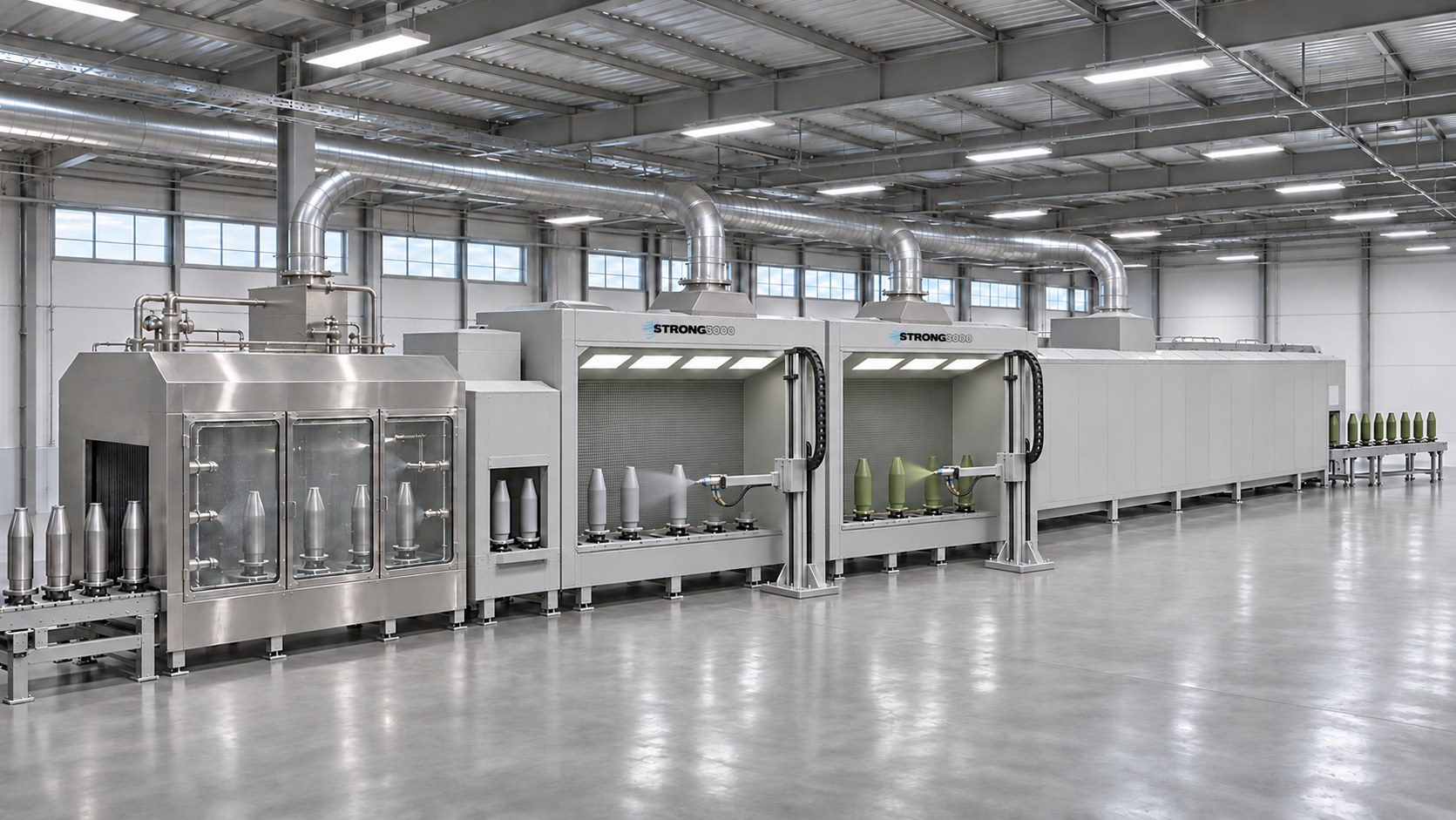
- The line consists of surface preparation, masking, primer, topcoat, curing, marking and inspection stations.
- For an even film the body is rotated on its own axis while the gun moves along its length.
Once an ammunition body has been produced it often waits in storage for years; it is transported through different climates, stacked and handled. Throughout that time the only thing protecting the surface is the coating. That is why painting, although it looks like the last step of production, is one of the most carefully planned sections of the line. This article covers only the painting process and the plant layout.
Why Ammunition Bodies Are Painted
Three things are expected of the body paint:
- Corrosion protection: The steel body must stay free of rust for a long time in humid and changing storage conditions. The protection comes not only from the paint but also from the surface preparation and primer beneath it.
- Identification: The body colour and the markings on it show the type of ammunition and the lot information. Colour shade and legibility of the lettering are therefore quality criteria.
- Dimensional fit: The coating must be thin and even enough not to affect the dimensional tolerances of the body. Too much thickness counts as a defect just as too little does.
Why Wet Paint
The reasons wet paint is preferred on ammunition bodies are related to the process:
- Thin, controlled film: With wet paint it is easy to apply a thin coat evenly, which suits tight dimensional tolerances.
- Low-temperature curing: Wet paint systems cure at room temperature or at low oven temperatures. The part is coated without being raised to a high temperature.
- Defined paint systems: The primer and topcoat systems used in this field are defined in the relevant specifications. The line is designed to the conditions in the technical data sheet of that paint system.
We cover the general properties of wet paint in detail in our article what is wet paint.
Tip
The paint system to be used must be settled before line design begins. Mixing ratio, flash-off time and curing condition directly determine the number of booths, the line length and the oven length.
Stages of the Line
On the lines we have built, the flow consists of the stations below. The number and order of stations change with capacity and the paint system.
| Stage | What is done | Point of attention |
|---|---|---|
| Loading | Bodies are placed on the carriers | Loading aid suited to the part weight, and ergonomics |
| Surface preparation | Degreasing, followed by phosphating or blasting | A clean, suitable surface for the paint to adhere to |
| Drying | Water on the surface is removed completely | No water left in blind spots |
| Masking | Areas not to be painted are covered | The mask seats fully and is reusable |
| Primer | The primer coat is applied to the rotating body | Even film and flash-off time |
| Topcoat | The colour-giving topcoat is applied | Colour shade and surface appearance |
| Curing and cooling | The paint is cured in an oven or in a controlled environment | The time and temperature given by the paint manufacturer |
| Marking | Lettering and markings are printed | Legibility and position accuracy |
| Inspection and unloading | Thickness and appearance are checked, masks are removed | Records and traceability |
Surface Preparation
This is the step that determines the life of the coating. Oil and cutting fluid residues from machining are first washed off. Then the surface required by the paint system is obtained: phosphating in a spray pretreatment tunnel, or roughening by blasting. The method to be used is determined by the paint system and the specification.
Masking
There are areas on the body that must not be painted: the rotating band, threads and seating surfaces come first among them. These areas are covered with cap and ring type masks before painting. In series production, fitting and removing the mask quickly and regularly cleaning off the paint that builds up on it are decisive for line efficiency.
Primer and Topcoat
The primer is the basis of corrosion protection, while the topcoat gives the colour and the resistance to external effects. The two coats are applied in separate booths, with the flash-off zone required by the paint system between them. Application takes place inside a wet paint booth.
Marking
Identifying lettering and markings are printed on the cured body. This station is at the end of the line, and the body is again rotated into position so that the print is in the correct place.
Automation and Part Movement
The way to get an even film on a cylindrical body is to rotate the part on its own axis at a constant speed and move the gun along its length. On the lines we have built, the bodies travel on carriers that receive a rotating motion inside the booth.
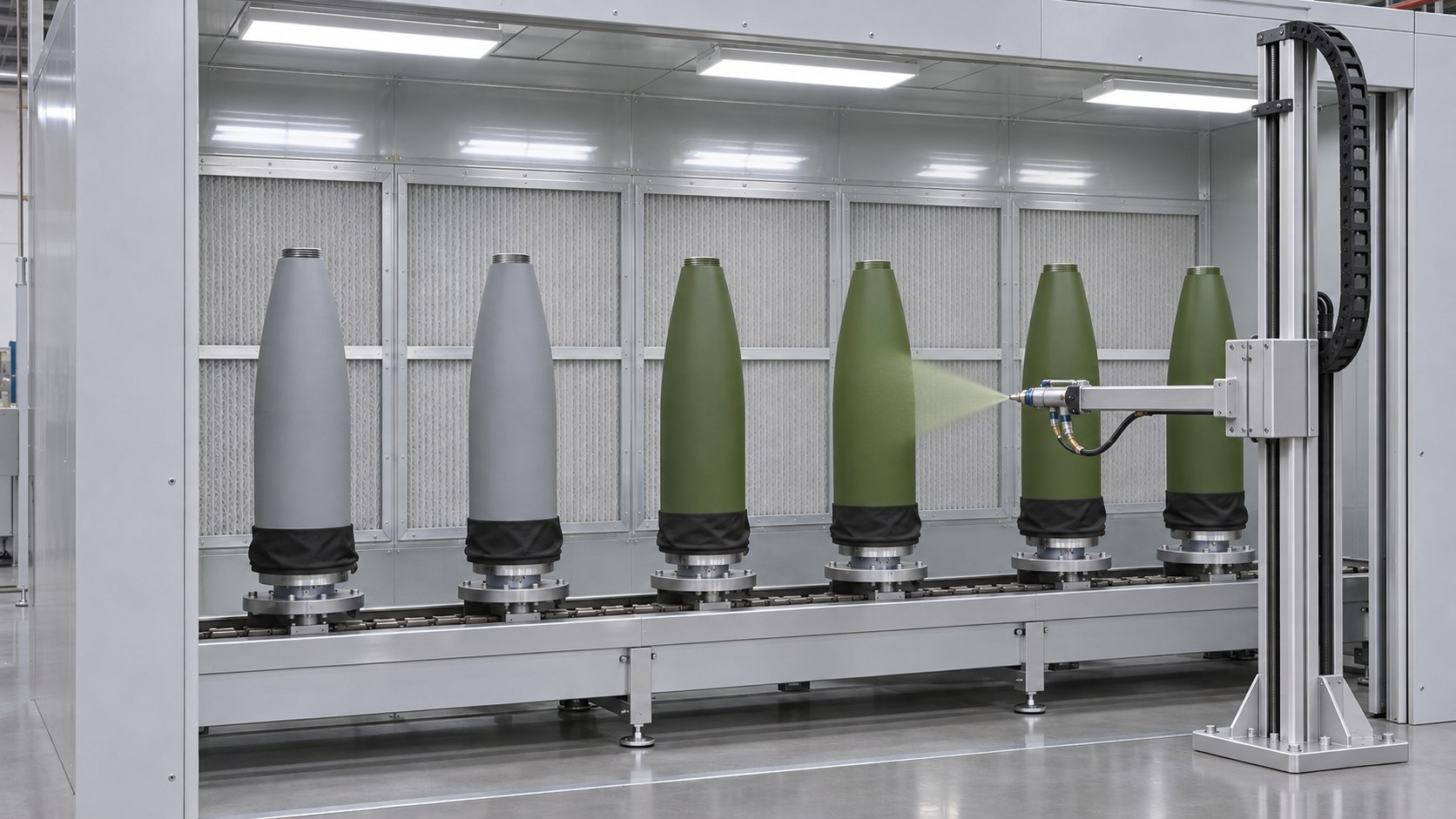
- Fixed automatic guns: In single-type, high-volume production, fixed guns arranged along the body are sufficient.
- Moving axis: The gun moves up and down along the body and adapts to different lengths by recipe.
- Robot: Preferred when the gun angle has to change on shaped areas such as the nose and base of the body.
Rotation speed, gun speed and paint flow rate are stored as a recipe for each body type. When the operator changes type, the settings are called up from the panel.
Booth, Ventilation and Safety
In wet paint application the booth has two jobs: capturing the paint mist that does not reach the part, and removing solvent vapour from the area.
- Capturing paint mist: A dry filter or water curtain booth is used. The choice is made according to paint consumption, shift pattern and waste management.
- Air balance: As much clean, filtered fresh air is supplied as is extracted from the booth. This balance affects both surface quality and the working environment.
- Explosion protection: In areas where solvent vapour is present, electrical equipment, lighting and motors are selected to suit that environment; parts and equipment are earthed.
- Paint preparation room: Paint mixing and supply equipment is kept in a separate, ventilated room.
Caution
With solvent-based paints the vapour is both flammable and harmful to health. Ventilation, equipment selection and personal protective equipment requirements are determined by the safety data sheet of the paint and the legislation in force.
Quality Control
In this field quality control is an integral part of production, and records are kept for every lot.
- Dry film thickness: Measured at defined points on the body after curing. For the measuring method see our article on film thickness measurement; the measuring device and method are the same for wet paint.
- Adhesion: The adhesion of the paint to the surface is tested on sample parts.
- Corrosion resistance: The resistance of the paint system is verified with the salt spray test.
- Appearance and colour: Runs, sags, dust and colour shade are checked by eye and by comparison with a reference sample.
- Traceability: Line parameters (recipe, temperature, time) are recorded together with the lot number.
Questions to Ask When Planning a Plant
Quotation and layout work for an ammunition painting plant starts with the following information:
- Part family: Diameter, length and weight of the smallest and the largest body.
- Capacity: Quantity per hour or per shift, and the working pattern.
- Paint system: Primer and topcoat type, number of coats, curing condition.
- Surface preparation: Phosphating or blasting; the condition in which the part arrives at the line.
- Area and infrastructure: Usable area, ceiling height, energy source and compressed air.
- Automation level: Whether loading, masking and marking will be manual or automatic.
Once this information is clear, the line type, the number of stations and the layout plan are worked out.
Frequently Asked Questions
Yes. Carriers and gun positions are changed by recipe according to diameter and length. On the lines we have built, the diameter changeover is made by selecting a recipe on the operator panel, while carrier adapters are prepared for each part family.
It depends on the paint system. In some systems the topcoat is applied over the primer after a short flash-off, in others the primer is cured separately. What decides is the technical data sheet of the paint to be used and the relevant specification.
Areas such as the rotating band, threads and seating surfaces are masked before painting. In series production, reusable cap and ring type masks are preferred; the masks are cleaned at set intervals.
The most reliable way to get an even film thickness on a cylindrical body is to rotate the part on its own axis at a constant speed and move the gun along its length. Every area then passes in front of the gun under the same conditions.
Body diameter and length range, part weight, hourly capacity, the paint system to be applied, the available area and the energy source. The line layout and the number of stations are determined from this information.