In Short
- Poor grounding directly reduces how well powder adheres to the part; transfer efficiency erodes and waste grows.
- The contact point between hanger and part must be clean metal; paint that builds up after a few cure cycles acts as an insulator.
- Hanger density and position are directly linked to shadowing and the Faraday effect.
- Measuring ground resistance takes minutes; neglecting it means tens of percent of waste over a shift.
If orange peel, low film build and recoats are increasing on a line, the first place people look is usually the gun or the powder. In most cases, however, the problem sits further back, in the hanging and the grounding. These two details are invisible; as long as you don't measure them, they keep growing waste for weeks.
In electrostatic application the powder particle is charged in the gun while the part is grounded. The charge difference pulls the particle to the part, and that attraction is also what holds it there until the oven. When any link in the chain is broken, the charged powder has nowhere to go; it either barely sticks to the part or scatters into the surroundings.
Why Grounding Is Essential
Charged powder deposited on the part has to discharge to ground. If it cannot, charge builds up on the part surface. The accumulated charge repels incoming particles; beyond a certain thickness the powder no longer adheres and bounces back. In the field this is called back ionization, and it shows up on the surface as crater-like bubbling, pinholing and low thickness.
With good grounding, the resistance between the part and plant ground must be low. In practice the target is below 1 megohm (MΩ); many applicators require 0.5 MΩ or less. Above this value, transfer efficiency drops noticeably. Measurement is simple: use a ground resistance meter (or a good multimeter on a low-ohm range) between the part surface and the conveyor ground. Choose an unpainted, clean spot on the part for the probe.
Tip
At the start of each shift, measure ground resistance on a few random hangers and log it. If the value climbs during the day, the problem is not a single bad part; it is the hangers slowly becoming insulated by built-up paint. The trend tells you more than a single reading.
The grounding chain is not just the hanger: it is the part, the hanger hook, the carrier bar, the conveyor trolley wheel and finally plant ground. Grease in the bearings, paint build-up on the conveyor rails and loosely bolted connections create invisible resistances in this chain. The main point where the conveyor is bonded to ground and the sliding contacts should be checked periodically.
Good Contact
No matter how good the grounding is, it is useless if the part does not touch the hanger at a conductively clean point. The contact point must be bare metal that paint cannot reach. That is why on most hangers the tip carrying the part is designed so it does not end up under cured paint; a sharp tip or a spring-loaded contact bites into the metal every cycle and opens a fresh contact.
A common mistake is forcing the contact mark into a hidden spot for “aesthetic” reasons. A contact mark is unavoidable; powder cannot settle at that point because it is effectively masked. The right approach is not to ignore the mark but to place it deliberately on an area of the part that is not visible in assembly or use. There is no hanger that leaves no mark; there are hangers that manage the mark.
The most insidious factor that degrades contact quality is paint building up on the hanger. Every pass through the oven, the hanger itself picks up some powder and it cures. Cured polyester or epoxy film is an excellent insulator; after a few cycles, yesterday's perfect contact becomes today's resistance of several megohms. This is a common situation under adhesion problems, but its cause is often looked for in the wrong place.
Hanger Design
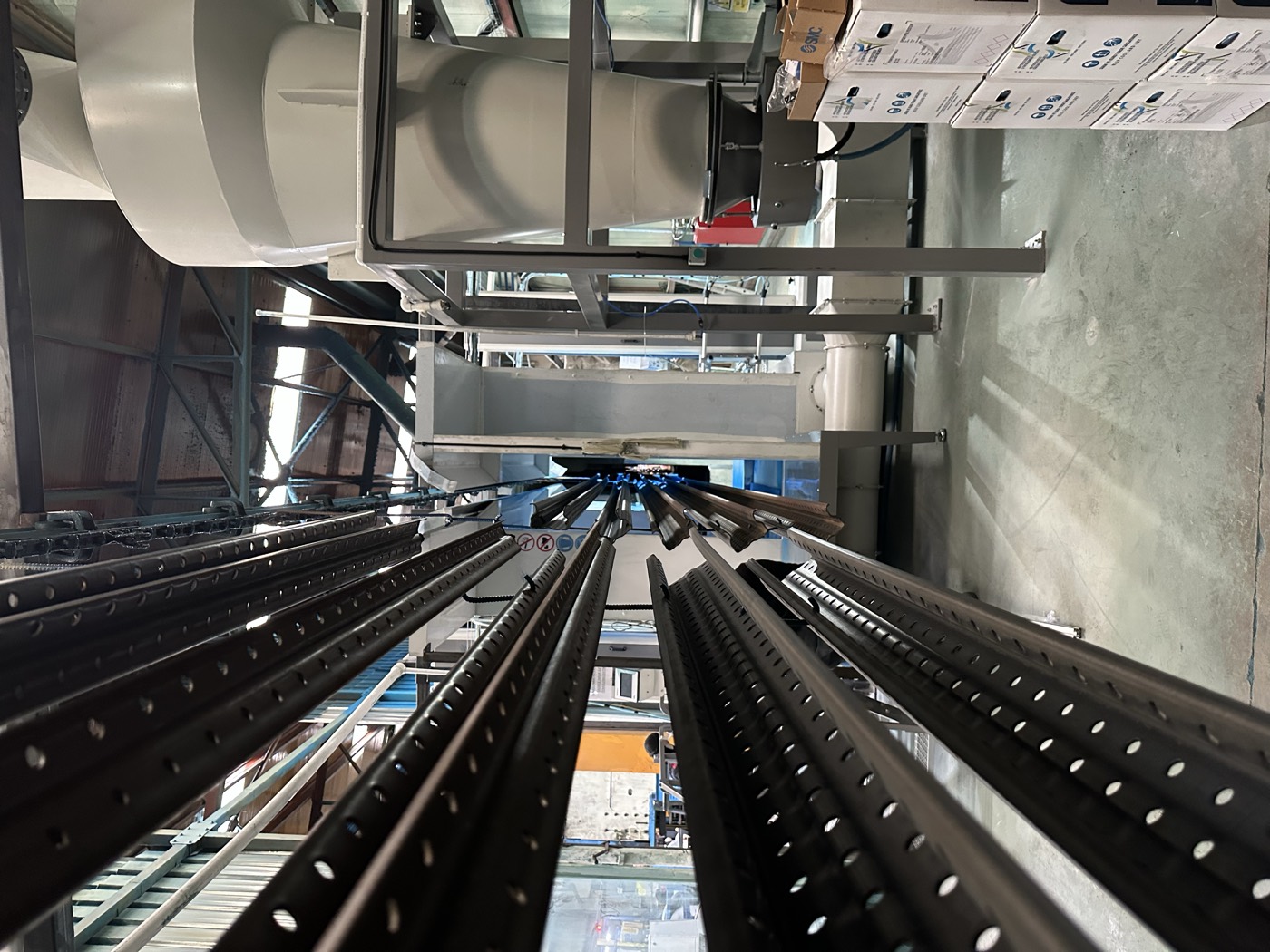
A hanger does three jobs at once: it carries the part mechanically, it establishes the ground path and it leaves the powder an angle of application. These three often conflict. Packing parts closer raises capacity but creates shadowing; spacing them out opens up the surfaces but lowers line throughput.
Shadowing is when one part blocks another's powder flow and electrostatic field. When two panels are hung too close side by side, their facing surfaces receive little powder. Part geometry, number of guns and line speed must be considered together when deciding. As a general starting point, leaving at least 40–60 mm between neighboring parts lets the facing surfaces breathe; the exact value is confirmed by field trials depending on the part shape.
On concave and recessed parts, hanging is intertwined with the Faraday effect. On a box section, cabinet body or channel-shaped part, field lines concentrate at the edges and powder struggles to reach the inner surface. The hanger should rotate or tilt the part to keep these areas open to the gun. At this point the physics of the job meets electrostatic behavior, and the application side meets gun motion.
| Hanging decision | Effect on capacity | Effect on quality |
|---|---|---|
| Packing parts closer | Increases | Shadowing, low film on inner surfaces |
| Opening up the spacing | Decreases | More even film, less touch-up |
| Hanging the part tilted/rotated | No change | Better access to recessed areas |
| Double contact instead of single | Slightly decreases | Higher grounding reliability |
On robotic or reciprocator lines, hanger repeatability matters even more. If the part is not in the same position every time, the programmed gun path will not match. Fixed-slot, non-swinging hangers reduce quality fluctuations on these lines. On a line that wants to keep the advantage of automatic application, hanger design is at least as decisive as the gun; in this respect it also directly affects the choice between automatic and manual application.
Hanger Maintenance
Hanger maintenance is one of the most neglected jobs in most plants, yet one with the highest return. The goal is to return the contact points to bare metal. There are two common methods: burning the paint off to ash in a pyrolytic (burn-off) oven and a chemical stripping bath. In a burn-off oven the temperature is usually held in the 400–450 °C range; higher temperatures anneal and soften thin-section hangers, causing them to bend over time.
Another practical method is to mask only the contact tips and let the body get coated. The cured paint forms an insulating layer on the body, which makes the powder go to the part rather than the hanger. What matters is that the masked tip stays clean metal every cycle. Spring contacts do this on their own; fixed tips need periodic cleaning.
Approving a hanger because it “looks clean” is misleading. Even where it is transparent, cured paint can be an insulating film a few microns thick. The decision is made by measurement: if the resistance from the contact point to ground is above 1 MΩ, the hanger needs cleaning or replacement regardless of how it looks.
It is better to set the maintenance interval by measured resistance rather than a fixed calendar. On a line with mostly small parts and many contacts, hangers foul more slowly; with heavy parts and large contact surfaces, build-up accelerates. Splitting the hanger stock into two groups and rotating them means the line does not have to stop while one group is being cleaned.
The link that ties up transfer efficiency
Transfer efficiency is the proportion of powder leaving the gun that actually adheres to the part. The rest goes to recovery; however good the recovery is, the fines content of reused powder rises and quality gradually drops. In other words, low transfer efficiency is not just immediate waste; it also shortens the quality life of the powder.
When ground resistance rises from 0.5 MΩ to 5 MΩ, the drop in transfer efficiency is easily felt in the field; pushing more powder out of the gun to get the same appearance increases both thickness and waste. That is why, if a line shows an unexplained decline in efficiency, hanger cleanliness and ground resistance should be checked before the gun settings. More often than not, the cheapest fix is right there.
Hanging and grounding are the silent framework of coating quality. When set up correctly, nobody notices; when they deteriorate, the bill seems to land on the gun, the powder or the oven. A few minutes of measurement each week and regular hanger cleaning keep these two details visible and manageable.
Frequently Asked Questions
Charged powder adheres to the part only if it can discharge to ground. When resistance rises, charge builds up on the surface, repels incoming powder and transfer efficiency drops. In practice, part-to-ground resistance is kept below 1 MΩ.
Paint that cures onto the hanger in every oven cycle forms an insulating film at the contact point. After a few cycles ground resistance climbs into the megohms and powder no longer goes to the part as it should; the result is low film build and waste.
It is the proportion of powder leaving the gun that adheres to the part. Low efficiency both increases immediate waste and raises the fines content of recovered powder, shortening the powder's quality life.