Summary
- Powder particles are charged in two ways: corona (ion bombardment with high voltage) and tribo (charge transfer by friction).
- Higher kV does not mean more charge; beyond a certain point the Faraday cage effect and back ionization come into play.
- What provides adhesion is the electric field lines; the same field also wraps partly around the back of the part (wrap-around).
- With corners, cavities and fine powder, the limits of electrostatics become clear; kV/µA settings and gun motion are decisive here.
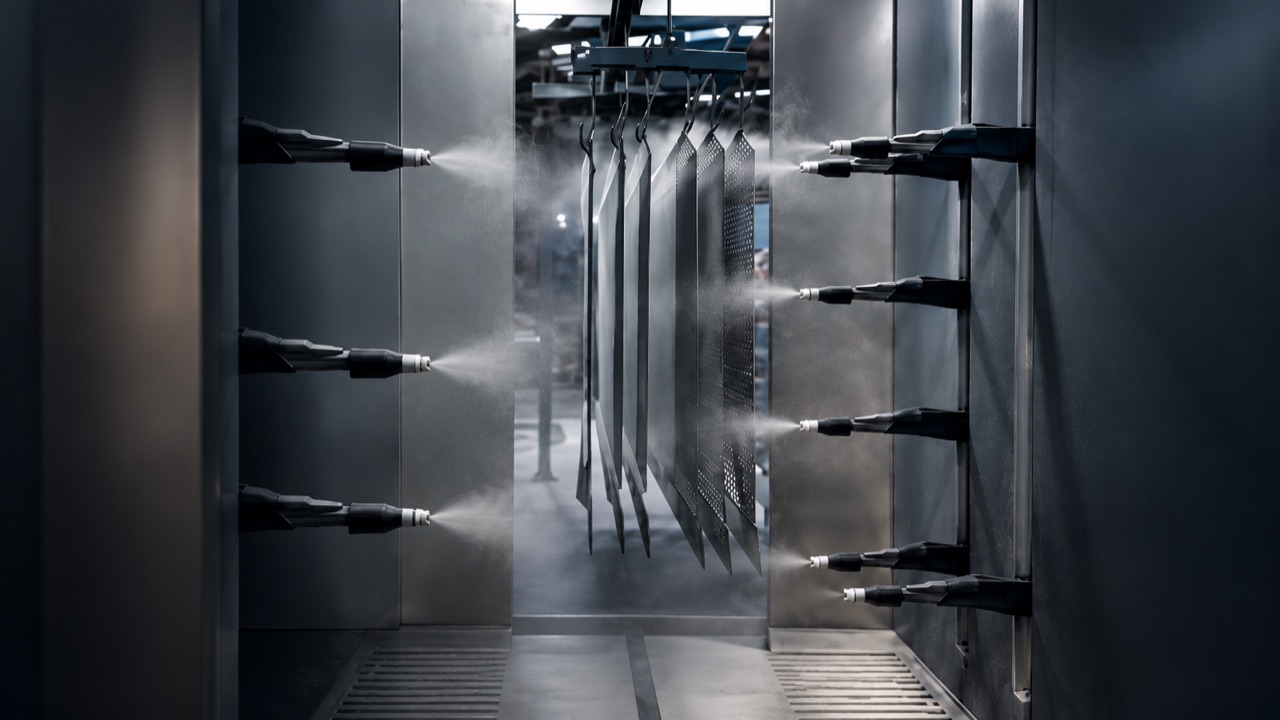
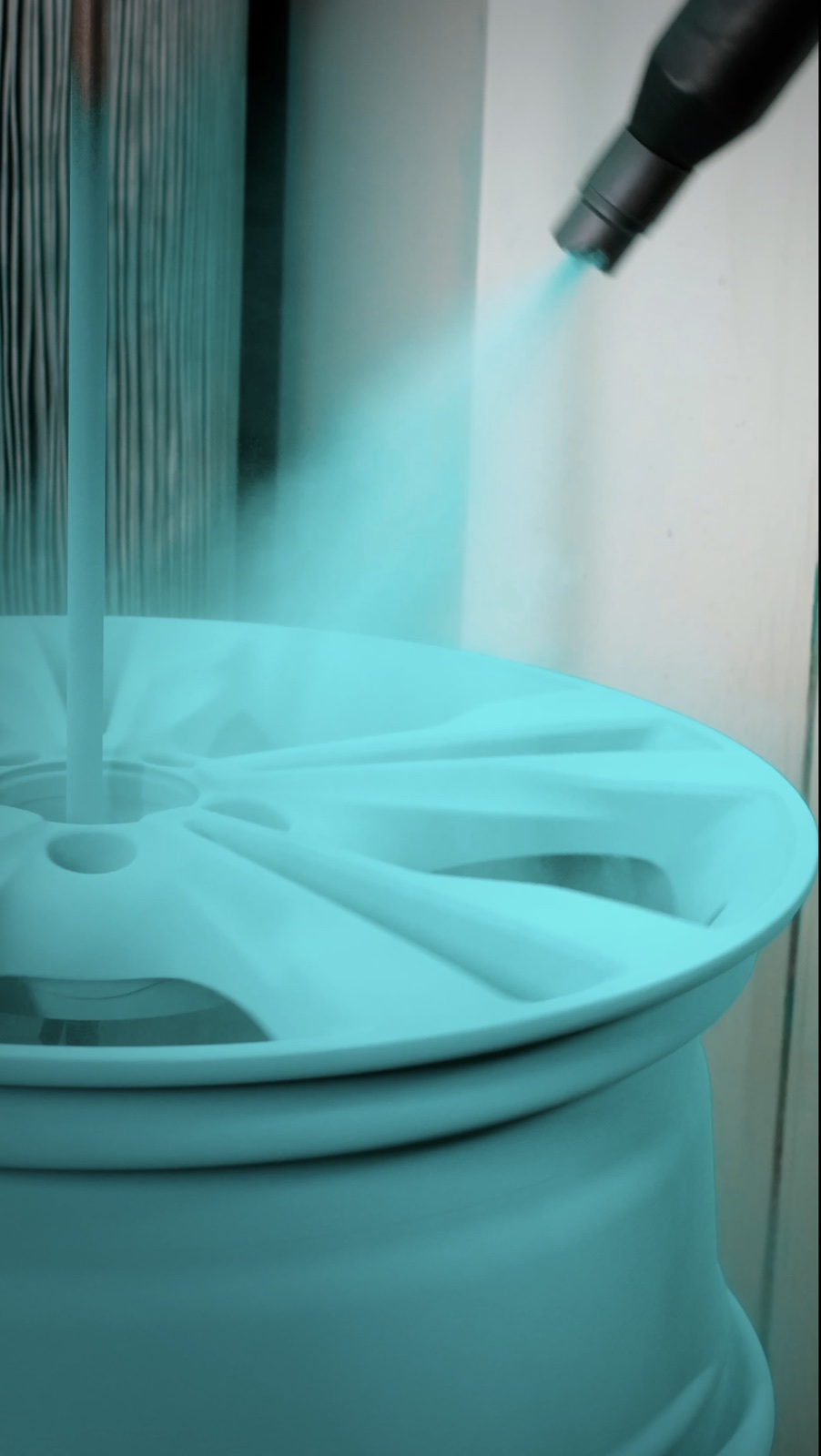
When you pull the trigger of a powder gun nothing visibly happens: the powder cloud travels toward the part and sticks. What makes it stick is not mechanics but electricity. The particles are electrostatically charged, the grounded part represents the opposite pole, and the powder is attracted to the metal. Until it enters the curing oven, this is the only force holding the coating on the surface. To understand the system, it helps first to know the answer to what is powder coating; the focus here is why and how that powder adheres to the surface.
Electrostatic powder coating is the process of giving dry polymer + pigment particles an electric charge, spraying them onto grounded metal and then baking them into a film. The quality of the process depends largely on the quality of charging. The same powder gives a patchy, pinholed film with a poorly charging gun and a smooth, well-covering film with a well-tuned gun.
How Charging Works
There are two ways used in the field to charge a particle: corona and tribo. Both end up charging the particle, but their methods and behavior differ.
Corona charging (ion bombardment)
A corona gun has a thin electrode at its tip. A high voltage on the order of 60–100 kV is applied to this electrode. The air at the electrode tip is ionized, creating a zone filled with free ions. Powder particles leaving the gun pick up charge as they pass through this ion cloud. In other words, the particle is charged not directly by the electrode but by the ions around it.
Corona is a fast and powerful method and works smoothly with different powder chemistries (epoxy, polyester, hybrid). Its drawback is that the same ion cloud also produces free ions. When these free ions pile up on the part surface, especially in cavities and corners, they trigger the back ionization and Faraday problems we will see later.
Tribo charging (friction)
A tribo gun has no high voltage. Particles gain charge by rubbing against a special material inside the gun (usually PTFE). During friction, electrons are transferred between particle and surface; the particle becomes positively charged and the gun discharges the opposite charge to ground. Since no free ions are produced, the ion cloud and back ionization typical of corona are absent here.
The practical result is this: tribo gives a more flexible spread on parts with deep cavities and corners, because there is no ion field pushing the particles away from the inside. On the other hand, tribo charging is sensitive to powder chemistry and depends on wear inside the gun; not every powder charges with the same efficiency in every tribo gun. Our in-depth tribo or corona article helps you decide based on part geometry.
| Feature | Corona | Tribo |
|---|---|---|
| Charging mechanism | Ion bombardment (60–100 kV) | Friction (no voltage) |
| Free ions | Yes | No |
| Faraday/corner behavior | Weak (ion field does not penetrate) | Better |
| Sensitivity to powder chemistry | Low | High |
| Transfer efficiency (flat part) | Generally high | Medium to high |
The Effect of kV and µA
Two values are monitored on corona guns: kV (applied voltage) and µA (current flowing from the electrode). A common mistake is the assumption “the higher the kV, the better.” In reality the relationship is not linear.
Higher kV produces a stronger electric field and more ions, which speeds up initial charging. But beyond a certain point, excess ions accumulate on the part surface. The charge building up on the surface starts to repel incoming particles and limits the coating's film thickness. At the same time, an excess of free ions leads to back ionization: as the accumulated charge discharges, it leaves small craters and pinhole-like defects in the film.
That is why the µA (current) limit matters. On modern guns, even if kV appears constant, the current limiting function controls the amount of ions leaving the electrode. On parts with deep corners and cavities, pulling kV down to the 40–60 kV band and limiting the current reduces ion bombardment and lets the particle enter the cavity. On flat, wide surfaces, 80–100 kV generally works without problems.
Tip
Change the kV setting according to part geometry; don't leave it fixed. Rule of thumb: high kV (80–100) for flat, wide surfaces; low kV (40–60) with a current limit for parts dominated by deep corners/cavities. Moving the gun back a little (200–300 mm) for the first coat also lowers ion density. The exact band is confirmed in the powder's TDS and in field trials.
Adhesion and Wrap-around
Once a charged particle leaves the gun it is subject to two forces: the airflow carrying it forward and the electrostatic attraction pulling it toward the grounded part. Because the part is grounded, electric field lines form around it. These lines extend perpendicular to the surface, and charged particles follow them to settle on the metal.
Some of the field lines wrap around the part's edge and reach the back face. Some of the particles follow these lines and adhere to the back of the part, which is not sprayed directly. This is called wrap-around. On parts such as thin profiles and tubes, wrap-around coats part of the back even when spraying from one direction; it is a desirable effect that increases transfer efficiency.
Adhered powder is still held only by electrostatic force; it has no mechanical bond. The film at this stage is called a “green film” and is sensitive to touch. A permanent film forms only in the curing oven, when the part has reached its target temperature (PMT) and is held for 10–20 min. In other words, electrostatics is the carrier that delivers the coating to the oven; hardness and adhesion come from chemistry in the oven.
Caution
Good charging does not rescue poor grounding. Ground resistance to the part through hanger and conveyor should ideally be below 1 megohm. Paint-coated, oxidized or oily hangers raise resistance; particles lose their attraction, transfer efficiency drops and wrap-around almost disappears. Regular thermal cleaning of hangers (burn-off/cooling) restores grounding.
The Limits of Electrostatics
Electrostatic charging works almost flawlessly on flat, open surfaces. Its limits appear as the geometry gets harder and the powder gets finer.
- Faraday cage effect: In areas such as inside corners, deep cavities and channels, electric field lines head not to the surface but to the nearest edge. Particles collect on the edges before they can reach the bottom of the corner; the inside of the cavity stays bare. This is the most pronounced limit of corona systems. We covered the mechanism and practical solutions in detail in the Faraday cage effect article.
- Back ionization: When excess charge builds up on the surface, it discharges in small sparks. Each discharge point leaves a small crater in the film; the surface looks pitted, like sand grains. The fix is to lower kV/µA and increase the gun distance.
- Fine powder behavior: Very fine particles below 10 μm carry a lot of charge per unit mass but are light against the airflow. They cannot enter cavities, change direction easily and, as they build up in recovery, upset the charging balance. Heavily recycled, fines-rich powder lowers charging efficiency.
- Humidity and conductivity: At high relative humidity the particle loses its charge faster; a dry environment keeps charging stable. Moisture pickup by the powder also disrupts charging.
Most of these limits are overcome through settings and motion: choosing kV/µA by geometry, aiming the gun angle into the cavity, switching to a tribo gun that has no ion field pushing back from the inside, and moving the gun evenly along the part surface with reciprocators or intelligent motion systems. Where deep Faraday zones remain, manual touch-up is often unavoidable. Systems that move the gun along the part contour and keep its distance constant (for example motion-controlled guns such as the OWL Intelligent Motion Gun) measurably increase transfer efficiency in these zones; but the physics doesn't change, it is just managed better.
In summary, electrostatic powder coating delivers high transfer efficiency and a smooth film with the right kV, the right current, solid grounding and gun motion suited to part geometry. The weak link in the system is usually not the gun itself; it is grounding, ion excess and overlooked geometry.
Frequently Asked Questions
Corona charges the particle with an ion cloud produced by 60–100 kV high voltage and generates free ions. Tribo uses no voltage; the particle is charged by friction inside the gun and no free ions are produced. That is why tribo generally spreads better on parts with deep corners and cavities.
Corona guns typically operate in the 40–100 kV band. 80–100 kV suits flat, wide surfaces; for parts with deep corners and cavities, 40–60 kV and a current limit are preferred. The exact value is confirmed by the powder's technical datasheet and field trials.
No. Beyond a certain point, excess ions accumulate on the part surface, repel new particles and limit film thickness. They also cause back ionization, creating craters and pitting in the film. Adjusting kV to the geometry is better than keeping it fixed at a high value.